2
1
4
3
5
6
7

PRODUCTS


An IOT solution service provider integrating modules, equipment, software and Solutions

SOLUTION


Create personalized industry solutions to help enterprises create new business models in the Internet of things Era

Smart Shelf Safety Monitoring System Solution

Smart Shelf Safety Monitoring System Solution

Smart Shelf Safety Monitoring System Solution

Smart Shelf Safety Monitoring System SolutionPrevent Shelf Collapse, Ensure Personnel and Cargo Safety Structural Stability Monitoring: Shelf tilting may result from foundation settlement, overloading, forklift collisions, or long-term uneven stress. If not addressed promptly, it may lead to collapse accidents.Early Warning: Slight tilting is hard to detect with the naked eye, but through tilt sensors or regular inspections, potential hazards can be identified in advance to avoid catastrophic consequences.Avoid Cargo Sliding or Damage Center of Gravity Balance: Shelf tilting causes cargo center of gravity to shift, especially for high-level shelves or heavy goods, which can easily lead to sliding or tipping, causing cargo damage or even personnel injury.Special Cargo Protection: Precision instruments, fragile items (e.g., glass, electronics) have higher requirements for shelf levelness; even slight tilting may cause packaging damage or product breakage.Adapt to Automated Warehouse Systems (e.g., AGV/Stacker Crane) Precise Positioning Requirement: Automated warehouses rely on standard shelf arrangement; if tilting exceeds the allowable range (e.g., ±0.5°), it may cause stacker crane picking failures or collisions.System Linkage: Real-time tilt data can be fed back to the Warehouse Management System (WMS) to automatically adjust robot paths or pause operations in hazardous areas.Comply with Safety Regulations and Industry Standards Legal Requirements: Regulations such as OSHA (Occupational Safety and Health Administration, USA) and GB/T Code for the Use of Storage Shelves require regular inspection of shelf structures; if tilt exceeds limits, shelves must be taken out of service for repair.Insurance and Liability: Some insurers require enterprises to install tilt monitoring devices; otherwise, claims may be denied after an accident.Reduce Maintenance Costs, Extend Shelf Lifespan Preventive Maintenance: By monitoring tilt changes, determine whether to reinforce footings, adjust beams, or replace damaged components — preventing minor issues from escalating into major repairs.Reduce Downtime Loss: Sudden collapse can halt warehouse operations; regular inspections maximize operational continuity.Total Function of SystemTilt detection requires a complete system to ensure data usability. Our company has developed a full set of tilt monitoring system, which consists of front-end sensor inclinometers, wireless transmission, alarm terminals, mobile apps, and cloud platforms. Below, we will introduce wireless transmission, alarm terminals, cloud platforms, and tilt sensors respectively. The following is the block diagram of this system:The overall system is used as follows: An inclinometer is installed on each shelf and can be powered by battery or continuous power supply. Transmission options include LoRa, LoRaWAN, or Wi-Fi. A display terminal is placed in front of each group of shelves to show the tilt level of that particular shelf group.Immediate Alert at 0.1° Shelf Tilt!​Triaxial Inclinometer | 24/7 Monitoring | Anti-Collapse· Real-Time Monitoring · Intelligent Alarm · Multi-Protocol Transmission · Wireless TransmissionThis system employs three types of wireless transmission: LoRa/LoRaWAN, Wi-Fi, and CAT1 (4G). Each is tailored to a specific usage environment.LoRa/LoRaWAN​ is suited for large-scale localized environments with high demands on sensor power efficiency, long transmission range, and centralized management — such as logistics warehouse shelving systems.Wi-Fi​ is appropriate for environments where sensor power consumption is not critical and Wi-Fi coverage is available.CAT1 (4G)​ is designed for widely dispersed, large-scale environments — such as telecommunication towers or structurally unsafe buildings.FeatureLoRa/LoRaWANWiFiCat1 (4G)Transmission Range10–15 km (open area)50–100 m (open area)Dependent on 4G base station coverageData Rate0.3–50 kbps11 Mbps – 9.6 GbpsUplink 10 Mbps / Downlink 5 MbpsPower ConsumptionExtremely low (5–10 years battery life)High (requires continuous power)Medium-low (supports battery power)Frequency Band470–510 MHz (China)2.4 GHz / 5 GHz / 6 GHzGlobal LTE bands (e.g., B1/B3)Network ArchitectureStar topology (Terminal → Gateway → Cloud)Point-to-point / AP-centricCellular network (Base Station → Core Network)Typical ScenariosLogistics shelving, Agricultural monitoringIndoor devices, Smart homeTower monitoring, Dangerous building inspectionAdvantagesUltra-long range, Low power, Anti-interferenceHigh speed, High-density connectivityWide coverage, Strong mobilityLimitationsLow data rate, Dependent on gateway deploymentHigh power consumption, Wall penetration lossSignal dependent on base stations, Higher costCloud PlatformCore FunctionsMulti-Protocol Device AccessSupports tilt sensors接入 via multiple communication protocols including Wi-Fi, LoRa/LoRaWAN, and Cat1Automatically identifies device type and communication protocolProvides standardized device access interfacesReal-Time Dat
MORE

Wireless Temperature Monitoring Terminal

Wireless Temperature Monitoring Terminal

Wireless Temperature Monitoring Terminal

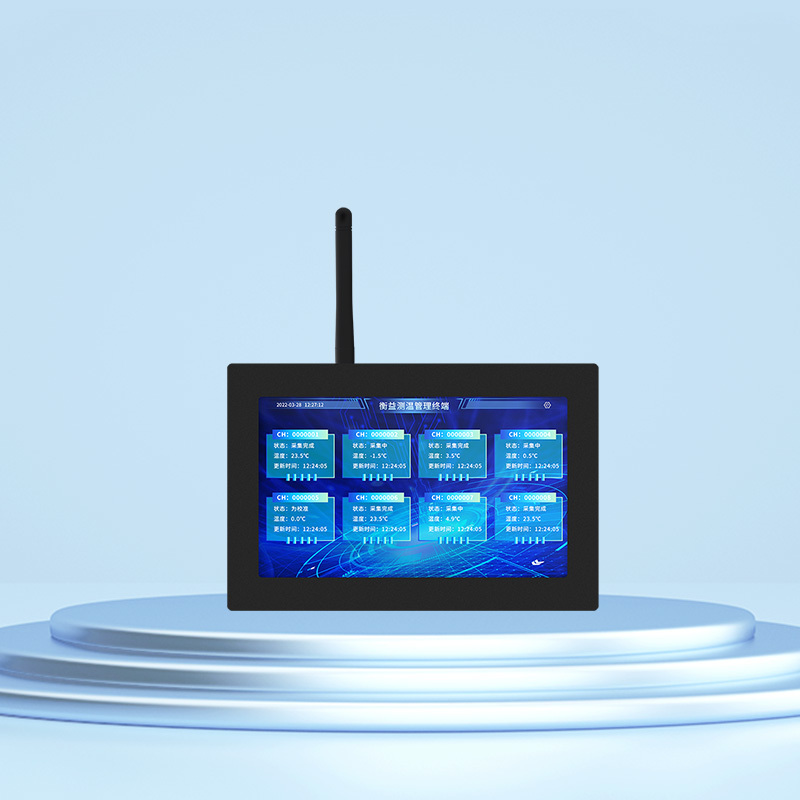
Wireless Temperature Monitoring TerminalI. FunctionsOur company has developed a wireless temperature monitoring terminal. It supports both wired and wireless reception of data from sensors measuring temperature, humidity, air quality, and more. The terminal not only stores received data locally but also uploads it to cloud platforms via Ethernet or 4G/5G networks.II. Product Specifications2.1 System FeaturesThe terminal is embedded with a high-speed CPU operating at up to 1.2 GHz, equipped with 128 MB of RAM and 4 GB of external eMMC storage. Its large storage capacity allows it to retain data from multiple sensors for over 10 years. The high-performance CPU enables in-depth analysis of long-term sensor data. Additionally, the device features an external 10.1-inch touchscreen for intuitive operation.The terminal offers versatile interfaces. Internally, it supports wireless protocols (LoRa/LoRaWAN), wired RS485, and I/O connections, allowing integration with various sensors to form a compact system. Externally, it supports 4G/5G and RJ45 connectivity for uploading sensor data to cloud platforms. It can also interface with external control equipment through I/O linkages. The following illustrates some system configurations utilizing this terminal.Wireless Temperature Monitoring Terminal Wireless Temperature Monitoring SystemInfrared Temperature Measurement System2.2 Product Introduction• Product FunctionsThe wireless temperature monitoring terminal provides unified management for multiple sensor channels. It displays real-time data from multiple sensors simultaneously on-screen and handles data logging, transmission, and analysis. The terminal can interface with external control equipment—such as sprinkler systems, fans, and humidifiers—via I/O and RS485 linkages to trigger automated responses.• Product Images• Product ParametersItemParameterRemarksDisplay Functions​Display Type​TFT True ColorDisplay Resolution​1024 × 600Touch Type​High-Precision Capacitive Touch ScreenNumber of Sensors Displayed​Supports multiple display styles: full-screen single view, dual-view, up to 16 sensors simultaneouslyDisplay Size​10.1 inchesSystem Functions​Real-time Data​Displays real-time sensor data on screen via multiple visualization modesHistorical Data​Stores over one year of historical data; easily accessible and viewable via touch screenOperation Method​Direct finger operation on screen; supports zoom in/outSupported Sensor Types​Temperature & Humidity, Temperature, PM2.5/PM10, TVOC, Formaldehyde, CO₂, etc.Data Upload​10/100M Ethernet and 3G/4G/5GCommunication Protocol​Local: LoRa, LoRaWAN for sensor integrationRemote: MQTT for cloud platform integrationLocal Wireless​Supports LoRa wireless communication; Frequency Band: 31 MHz ~ 915 MHzProduct Specifications​Operating Temperature​-30℃ ~ 65℃Operating Humidity​5% RH ~ 90% RHCertifications​CE / FCCPower Supply​6V ~ 12V III. Application ScenariosLeveraging the core strengths of the wireless temperature monitoring terminal—including multi-sensor compatibility, wide-temperature operation, long-term data storage, remote management, and intelligent linkage—its applications span industrial, warehousing, environmental, agricultural, public infrastructure, medical, and other sectors. Specific scenarios include:3.1 Industrial Sector: Electrical Equipment & Production Environment MonitoringCore Scenarios:​ Temperature monitoring in high/low-voltage electrical cabinets, environmental monitoring in industrial workshops, and temperature monitoring of production equipment.Rationale:Supports LoRa wireless communication (eliminating the need for wiring, ideal for complex industrial layouts) and integrates with single-point/matrix infrared temperature sensors (as described in the "Infrared Temperature Measurement System" section) to monitor critical points such as contacts in electrical cabinets and motor windings in real time, preventing overheating failures;Operates reliably within a wide temperature range of -30℃ to 65℃, withstanding extreme industrial conditions;Capable of linking with cooling fans or sprinkler systems to automatically activate cooling when temperatures exceed set thresholds, ensuring equipment safety;Stores data for over 10 years, enabling traceability of temperature trends to support predictive maintenance.3.2 Warehousing & Logistics: Cold Chain & Hazardous Chemical Storage MonitoringCore Scenarios:​ Food cold chain storage (e.g., fresh produce, frozen foods), pharmaceutical cold chain (e.g., vaccines, reagents), and hazardous chemical warehouses (e.g., temperature and humidity monitoring of flammable materials).Rationale:Supports temperature and humidity sensors for real-time environmental monitoring, with data stored locally and uploaded to the cloud, meeting cold chain "full traceability" requirements (e.g., fulfilling GSP certification mandates for temperature logging in pharmaceuticals);The 10.1-inch touchscreen facilitates on-site checks by warehouse personnel,
MORE
Smart Shelf Safety Inspection Solution

Smart Shelf Safety Inspection Solution

Smart Shelf Safety Inspection Solution

Smart Shelf Safety Inspection SolutionIndustry LandscapeIn logistics facilities, shelving units are typically tall, densely packed with heavy inventory, and require year-round real-time tilt monitoring to achieve the following objectives:Prevent Shelf Collapse and Ensure Personnel and Cargo SafetyStructural Stability Monitoring: Shelf tilting can result from foundation settlement, overloading, forklift collisions, or long-term uneven stress distribution. If left unaddressed, this may lead to catastrophic collapse.Early Warning: Minor tilts are often imperceptible to the naked eye; however, utilizing tilt sensors or regular inspections enables early detection of potential hazards, preventing disastrous outcomes.Prevent Cargo Sliding or DamageCenter-of-Gravity Balance: Tilted shelves cause cargo to shift off-center—particularly on high-level racks or with heavy loads—significantly increasing the risk of sliding, toppling, cargo damage, and even personnel injury.Specialized Cargo Protection: Precision instruments and fragile goods (e.g., glass, electronics) demand higher shelf levelness; even slight tilting can result in packaging damage or product defects.Compatibility with Automated Storage Systems (e.g., AGVs/Stacker Cranes)Precision Positioning Requirements: Automated warehouses rely on standardized rack alignment. If tilt exceeds permissible limits (e.g., ±0.5°), stacker cranes may fail to retrieve goods or risk collision.System Integration: Real-time tilt data can be fed back to the Warehouse Management System (WMS) to automatically adjust robotic pathways or suspend operations in hazardous zones.Compliance with Safety Regulations and Industry StandardsLegal Requirements: Standards such as OSHA (Occupational Safety and Health Administration) and GB/T Code for Use of Storage Shelves mandate regular structural inspections; racks exceeding tilt thresholds must be taken offline for repair.Insurance and Liability: Some insurers require the installation of tilt monitoring devices; otherwise, claims may be denied following an incident.Reduce Maintenance Costs and Extend Rack LifespanPreventive Maintenance: Monitoring tilt variations helps determine the need for footing reinforcement, beam adjustment, or replacement of damaged components, preventing minor issues from escalating into major repairs.Minimize Downtime Losses: Sudden collapses can halt warehouse operations, whereas routine inspections maximize operational continuity. Shelf tilt monitoring is a low-cost, high-return safety measure in logistics warehouse management, and it is particularly critical for high-bay racks, automated warehouses, or high-frequency operational environments. Leveraging IoT technology, our company has developed an unmanned shelf tilt monitoring system that significantly reduces accident risks and ensures the stable operation of storage systems through continuous IoT-based inspection.Tilt Monitoring SystemOverall System FunctionTilt detection requires a complete system to ensure the usability of the data. Our company has developed a full-fledged tilt monitoring system comprising front-end tilt sensors, wireless transmission modules, alarm terminals, a mobile app, and a cloud platform. The following sections will introduce the wireless transmission modules, alarm terminals, cloud platform, and tilt sensors respectively. Below is the system architecture diagram.The entire system operates as follows: One tilt sensor is installed on each shelf, powered either by battery or via constant power supply. Data transmission supports LoRa, LoRaWAN, or Wi-Fi. A display terminal is placed at the front of each rack group to visually indicate the tilt status of that specific group.2.2 Wireless TransmissionThis system employs three wireless transmission technologies: LoRa/LoRaWAN, Wi-Fi, and Cat1 (4G). Each is tailored to distinct deployment scenarios. LoRa/LoRaWAN is suited for large-scale localized environments—such as logistics shelving—where sensors require low power consumption, long-range transmission, and centralized management. Wi-Fi is ideal for settings with existing Wi-Fi coverage and no stringent power constraints. Cat1 (4G) targets highly dispersed, expansive environments, such as communication towers or structurally compromised buildings. These three wireless technologies are briefly introduced below.CharacteristicLoRa/LoRaWANWi-FiCat.1 (4G)Transmission Distance10-15km (open area)50-100m (indoor)Depends on 4G base station coverageTransmission Rate0.3-50kbps11Mbps-9.6GbpsDownlink 10Mbps / Uplink 5MbpsPower ConsumptionExtremely low (5-10 years battery life)High (requires continuous power)Medium-low (supports battery power)Frequency Band470-510MHz (China)2.4GHz/5GHz/6GHzLTE global bands (e.g., B1/B3)Network ArchitectureStar (terminal → gateway → cloud)Point-to-point/AP centralized蜂窝网络 (base station → core network)Typical ScenariosLogistics racks, agriculture monitoringIndoor devices, smart homeTower monitoring, dangerous building monito
MORE
Mushroom House Temperature and Humidity Management Solution

Mushroom House Temperature and Humidity Management Solution

Mushroom House Temperature and Humidity Management Solution

Mushroom House Temperature and Humidity Management SolutionI. Background and Core RequirementsMushrooms (such as shiitake, oyster, and enoki mushrooms) are highly sensitive to environmental conditions throughout their growth cycle—including the mycelium stage, primordium formation stage, and fruiting body development stage. Traditional mushroom house management relies on manual inspections, which often result in uneven temperature and humidity distribution, delayed parameter adjustments, uncontrolled CO₂ levels, and imprecise lighting. These issues can lead to high deformity rates, low survival rates, and inconsistent batch quality. Addressing current industry pain points and leveraging our product portfolio—which includes illuminance sensors, temperature and humidity sensors, carbon dioxide sensors, and a cloud platform—this solution focuses on four core requirements: precise monitoring, real-time alerts, intelligent control, and data traceability, effectively resolving the following key challenges:Temperature and Humidity Instability: Significant temperature and humidity variations exist across different zones of the mushroom house (e.g., shelf tiers, floor level, and ventilation outlets). For instance, shiitake mushrooms require 15–18°C and 85–90% humidity during the primordium stage—conditions that are difficult to regulate promptly through manual intervention.CO₂ Imbalance: Mushroom respiration generates CO₂. Excessively high concentrations (>1500 ppm) inhibit fruiting body development, while levels that are too low (<500 ppm) impair mycelial metabolism. Traditional monitoring lacks real-time data support.Inadequate Lighting: The mycelium stage requires darkness (<50 lux), whereas the fruiting body stage needs low light (50–500 lux). Manually operating supplemental lighting often results in deviations from target illumination levels.Lack of Data Traceability: The absence of historical environmental records prevents post-analysis and optimization of growth issues across different batches, leading to low efficiency in large-scale management.II. Solution Design PrinciplesPrecision Monitoring: Sensors are deployed in core growth zones of the mushroom house (e.g., middle tiers of cultivation shelves, dead corners of ventilation, and lighting areas) to ensure comprehensive, gap-free data coverage.Real-Time Alerts: Dynamic thresholds are configured (adjustable by mushroom variety and growth stage). When values exceed limits, the cloud platform instantly pushes SMS and app notifications to prevent delays.Intelligent Management: The cloud platform aggregates multi-dimensional data and supports automatic generation of growth reports to assist cultivation decision-making.Scalable Adaptation: Interfaces for smart devices (e.g., humidifiers, exhaust fans, supplemental lights) are reserved, enabling future upgrades to an integrated "monitoring-control" system.III. Core Solution Architecture (Layered Design)This solution adopts a four-tier architecture—Perception Layer, Transmission Layer, Platform Layer, and Application Layer—deeply integrating sensors with the cloud platform to achieve end-to-end environmental management of the mushroom house:Perception Layer: Environmental Data Acquisition Terminals (Core Product Implementation)As the primary data source, sensors are precisely deployed according to the spatial layout of the mushroom house and growth requirements, focusing on solving the issue of "data acquisition accuracy":Temperature and Humidity Sensors: Deployed at a density of one sensor per 50 m², prioritizing installation at the middle tier of cultivation shelves (core growth zone), floor level (to prevent water accumulation from high humidity), and ventilation outlets (to monitor intake and exhaust air conditions). High-humidity-adapted models are selected (measurement range: temperature 0–60°C, humidity 0–100% RH) to withstand the moist environment of mushroom housesHere's the English translation in plain text for you to copy:Wireless Temperature and Humidity SensorProduct FunctionUsed to monitor temperature and humidity in the mushroom house (fruiting room). Data is transmitted via LoRa / LoRaWAN / Cat 1.Product ImageProduct ParametersItemParametersRemarksFunctionDetects the temperature of objects and transmits ambient temperature and humidity data to the cloud platform or gateway via LoRa/LoRaWAN/Cat 1.Temperature Measurement Range-40°C ~ 125°CTemperature Measurement Accuracy±0.5°CTemperature Measurement Resolution0.1°CData Transmission MethodLoRa/LoRaWAN/Cat 1Default: LoRaWireless CommunicationSupports LoRa/LoRaWAN wireless communication with a frequency band of 31MHz~915MHzWireless communication is optional; default frequency band is 470MHzTemperature Measurement PointExternal probeOperating Temperature-20°C ~ 80°CPower SupplyTwo 18505 lithium iron batteries, 8000mAh​ Carbon Dioxide Sensor: Deploy two units per mushroom house (one at the center of the room and one at the ventilation outlet), with a mon
MORE
MORE

ABOUT US


Shenzhen Hengyi Technology Co., Ltd. was established in 2018. It is an IOT solution service provider integrating modules, equipment, software and solutions. It aims to create personalized industry solutions according to the characteristics of various subdivisions, and provides customers with one-stop service providers such as demand analysis, intelligent hardware, software systems and data analysis. It helps enterprises create new business models in the era of the Internet of things and promotes the industry's intelligence.

MORE

NEWS


MORE