
Does multi-point temperature measurement require installing multiple devices? A single probe enables three-layer monitoring, providing full coverage for tobacco leaves, tea leaves, and grain stacks.
Release time:
2025-05-19
In processes such as tobacco leaf aging, tea fermentation, and grain storage, uneven temperature distribution within the stacked material has long been a persistent challenge in the industry. Conventional monitoring methods rely on deploying multiple single-point sensors; while they may appear to provide comprehensive coverage, they actually harbor numerous hidden risks:
1. High costs: The bulk materials occupy vast volumes—such as 5-meter-high tobacco stacks or grain piles weighing thousands of tons—requiring the dense deployment of dozens of sensors, which in turn drives up procurement and maintenance expenses exponentially.
2. Cumbersome operation: Each sensor requires independent installation, wiring, and commissioning, which is time-consuming and labor-intensive; moreover, equipment is prone to damage during material handling or loading/unloading.
3. Monitoring blind spots: A single-point sensor can only capture local temperature, failing to reflect the true temperature differences among the upper, middle, and lower layers within the stack, thereby posing a risk of misjudgment—such as concluding that “the surface is normal while the interior is overheated.”
4. Data Silos: Data from multiple devices is scattered across different platforms, making integrated analysis challenging and hindering the timely identification of abnormal trends.
Wireless Plug-in Temperature Measurement System
I. Feature Introduction
Our company’s innovatively developed wireless plug-in temperature measurement system is a specialized solution to the challenging task of measuring internal temperatures within objects. Unlike conventional methods for monitoring ambient temperature and humidity,
This system is specifically designed to accurately measure the internal temperature of objects and, leveraging IoT technology, enables wireless data transmission, centralized management, and intelligent early warning, thereby filling a critical market gap in real-time internal temperature monitoring and remote management.
The entire system consists of front-end sensors, a wireless gateway, an alarm terminal, and a back-end platform. 。
The front-end sensor employs a high-precision, food-grade stainless steel probe that can be directly inserted into the object being measured (such as grain piles, building materials, tobacco stacks, vinasse, chemical raw materials, and more).
The overall structure meets IP68 protection standards, offering corrosion resistance and tolerance to high temperatures and pressures, making it suitable for harsh environments. Probe types are available, with options for different probe lengths (10 cm / 20 cm / 50 cm) and temperature measurement ranges (-40°C to 150°C / -40°C to 300°C), and custom configurations can be provided upon request.
The wireless gateway supports LoRa, LoRaWAN, and Wi‑Fi, leveraging low‑power wide‑area network technology with a transmission range of 3–5 kilometers (depending on the environment). A single gateway can simultaneously collect data from over 200 sensors. It also supports 4G/5G cellular connectivity and offers 100/1000 Mbps Ethernet wired transmission.
The alarm terminal is deployed on-site to display real-time sensor data on a screen, supports LoRa/LoRaWAN, features a 10.1-inch large display, and enables external data transmission via 4G/5G or Ethernet to the cloud platform.
Supports I/O input and output, enabling integration with control systems for fans, sprinklers, air conditioners, and more to achieve automated regulation. Also supports local data storage and retrieval.
The backend platform enables unified device management and provides capabilities for data storage, visualization, analysis, and alarm notification.
The specific block diagram is as follows:
II. Product Introduction
Front-end sensor
1. Wireless single-point plug-in temperature sensor
- Product Features
The wireless plug-in temperature sensor features a probe longer than 30 cm (with customizable length), and its tip houses a high-performance sensing element that accurately detects internal temperature changes. The device requires no wiring, Plug and play, Enables users to install and use it quickly. 。
The probe is equipped with a high-precision temperature sensor, enabling fast and accurate measurement of product temperature. Equipment The top is made of high-strength, impact-resistant composite material. , It is resistant to breakage from impacts or knocks. The device can transmit data to the cloud platform via a gateway, enabling real-time remote monitoring.
- Product image
- Product Specifications
| Parameter |
Note |
|
| Functionality |
Detect the internal temperature of the inserted object. |
|
| Temperature measurement range |
-40℃~180℃ |
|
| Temperature measurement accuracy |
±0.5℃ |
|
| Temperature measurement resolution |
0.1℃ |
|
| Data transmission method |
LoRa/LoRaWAN, customizable 4G (Cat1), Wi‑Fi, and other wireless communication options. |
|
| Wireless communication |
Supports LoRa/LoRaWAN wireless communication, with a frequency range of 31 MHz to 915 MHz. |
Wireless communication is an optional accessory; the default frequency band is 470 MHz. |
| Body temperature measurement site |
Needle tip |
|
| Thermometer probe length |
Customizable; default is 30 cm. |
|
| Operating temperature |
-20℃~80℃ |
|
| Power supply |
Battery: Two ER18505 cells |
|
| Service life |
More than 3 years |
|
2. Wireless multipoint plug-in temperature sensor
- Product Features
The multi-point insertion-type thermometer is an intelligent device designed for temperature monitoring in bulk materials. It employs advanced temperature-sensing technology to quickly and accurately measure the temperature at three distinct layers within the target material. Data is transmitted in real time to a cloud‑based platform via a gateway. With a simple insertion procedure, the probe can be swiftly extended into the interior of the measured object, providing a convenient means of temperature monitoring for product storage and preservation.
- Product image
- Product Specifications
| Project |
Parameter |
Note |
| Functionality |
Detect the internal temperature of the inserted object. |
|
| Temperature measurement range |
-40℃~180℃ |
|
| Temperature measurement accuracy |
±0.5℃ |
|
| Temperature measurement resolution |
0.1℃ |
|
| Data transmission method |
LoRa/LoRaWAN |
|
| Wireless communication |
Supports LoRa/LoRaWAN wireless communication, with a frequency range of 31 MHz to 915 MHz. |
Wireless communication is an optional accessory; the default frequency band is 470 MHz. |
| Body temperature measurement site |
The tip, the middle, and the tail |
|
| Thermometer probe length |
100CM |
|
| Operating temperature |
-20℃~80℃ |
|
| Power supply |
Powered by 3 AA batteries |
|
3. Wireless Plug-in Temperature Sensor
- Product Features
This product is a high-performance, high-sensitivity temperature data acquisition terminal, featuring… One-channel AD acquisition port, capable of connecting PT100/PT1000 thermistors. The resistance sensor converts measurements into temperature data via wireless transmission. Cat.1 uploads to the cloud platform, facilitating engineering network deployment and industrial applications, and supports platform integration.
- Product image
- Product Specifications
| Project |
Parameter |
Note |
| Functionality |
Detects the temperature of objects and transmits the temperature data to the cloud platform via LoRa, LoRaWAN, or Cat1. |
|
| Temperature measurement range |
-40℃~380℃ |
|
| Temperature measurement accuracy |
±0.5℃ |
|
| Temperature measurement resolution |
0.1℃ |
|
| Data transmission method |
LoRa/LoRaWAN/Cat1 |
Default LoRa |
| Wireless communication |
Supports LoRa/LoRaWAN wireless communication, with a frequency range of 31 MHz to 915 MHz. |
Wireless communication is an optional accessory; the default frequency band is 470 MHz. |
| Body temperature measurement site |
External probe |
|
| Thermometer probe length |
100CM |
|
| Operating temperature |
-20℃~80℃ |
|
| Power supply |
Two 18505 lithium‑thionyl batteries, 800 mA |
|
- Product dimensions
4. Wireless gateway
- Feature Introduction
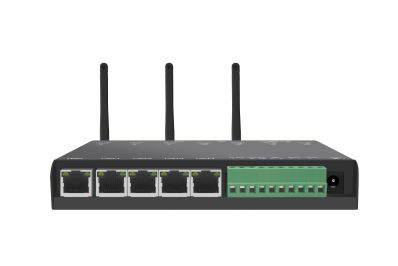
It RaWAN The gateway is based on low-power, wide-area network Lo… RaWAN The protocol’s IoT‑grade gateway router provides low‑power, mobile, and secure local two‑way wireless communication for IoT devices, supporting Lo… Ra, 2G/3G/4G/5G, Wi-Fi Multiple wireless communication features.
It RaWAN The gateway adopts a star‑topology architecture, with front‑end node devices communicating in a single hop to one or multiple Lo… RaWAN The gateway enables wireless communication between end devices and cloud servers, and can also communicate via standard I… P is connected to the cloud server.
It is widely used in smart cities, smart communities, smart campuses, smart oilfields, smart tobacco industries, and more.
- Product image
- Product Specifications
| Project |
Parameter |
Note |
|
| Product Functions |
LoRa functionality |
Supports the standard LoRaWAN protocol. |
|
| LoRa wireless communication features eight uplink channels and one downlink channel. |
|
||
| Mobile wireless functionality |
Supports Wi-Fi hotspot functionality. |
|
|
| LTE supports three mode options, covering China, Europe, and the United States; in China, it fully supports all network bands. |
|
||
| Supports Ethernet and 3G/ 4 G/5G uplink and downlink data backhaul, with support for automatic handover. |
|
||
| System Functions |
Supports overseas TTN servers |
|
|
| Supports switching between Chinese and English interfaces and setting the local time. |
|
||
| Supports remote administrator login for maintenance and troubleshooting. |
|
||
| Supports MQTT , supports W EB Interface Management |
|
||
| Supports restoring factory settings via button press or web interface. |
|
||
| Wireless Performance |
LORA wireless channel line |
8 channels |
|
| Work mode |
Full-duplex/Half-duplex |
|
|
| LoRa communication rate |
292b ps~5.4Kbps |
|
|
| Maximum transmit power |
27dbm |
|
|
| Maximum receiving sensitivity |
-141 dBm (SF=12) |
|
|
| Operating frequency band |
China 470 MHz Australia 923 MHz United States 915 MHz Europe 868 MHz |
The default is 470 MHz; customization is required for different frequency bands.
|
|
| Data Upload |
10/100M Ethernet and 3G/4G/5G |
5G is not supported by default. |
|
| LTE standard |
Domestic 4G supported frequency bands |
LTE-TDD: B38/B39/B40/B41 LTE-FDD: B1/B3/B5/B7/B8 TD-SCDMA: B34/B39 UMTS: B1/8 EVDO: 800 MHz CDMA1x: 800 MHz GSM: 850/900/1800/1900 |
|
| European 4G supported frequency bands |
FDD LTE :B1/B3/B5/B8/B20 TDD LTE: B38/B40/B41 WCDMA:B1/B5/B8 GSM : B3/B8 |
|
|
| U.S. 4G supported frequency bands |
FDD LTE: B2/B4/B12 WCDMA LTE: B2/B4/B5 |
|
|
| Wi-Fi |
Supports 802.11a/b/g/n protocols, 2.4 GHz band |
|
|
| Ethernet |
Supports 10M/100M adaptive network communication. |
|
|
| Product Specifications |
Operating temperature |
-30 °C ~65℃ |
|
| Operating temperature |
5%RH~90%RH |
|
|
| Authentication |
CE/FCC |
|
|
| Power supply |
DC Power supply, voltage: 6V–12V |
|
|
5. Alarm terminal
- Product Features
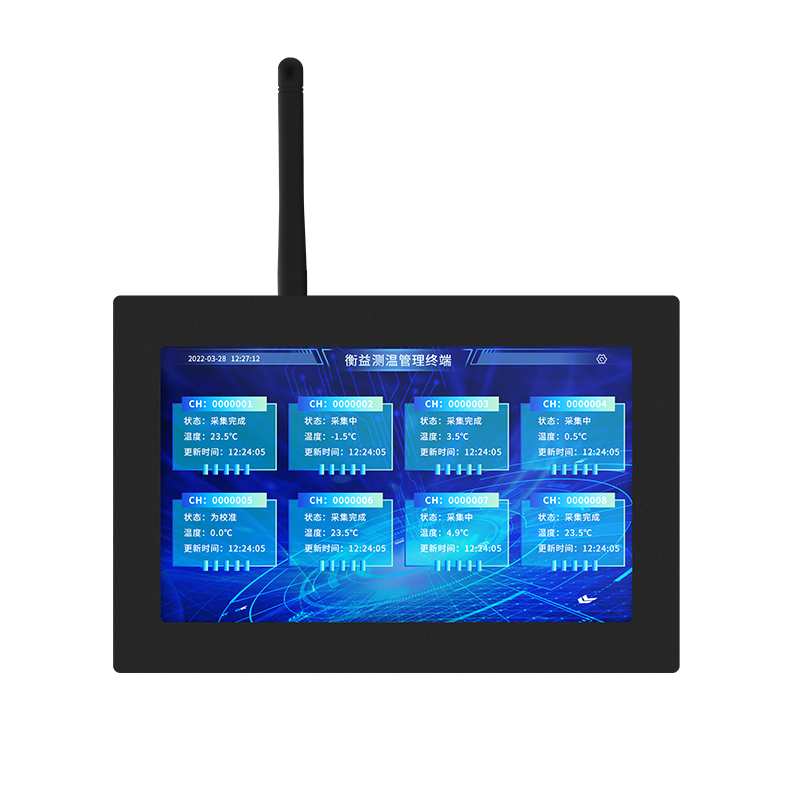
The alarm terminal provides unified management of multiple sensor channels. It can simultaneously display data from several sensors on the screen and store, transmit, and analyze the collected sensor readings.
The alarm terminal can interface with external control devices—such as sprinklers, exhaust fans, and humidifiers—via I/O and RS485 ports.
- Product image
- Product Specifications
| Parameter |
Note |
||
| Display Function |
Display types |
TFT true color |
|
| Display resolution |
1024X600 |
|
|
| Types of touch controls |
High-precision capacitive touchscreen |
|
|
| Sensor display count |
Supports multiple display modes: you can show one item in full screen, or two; up to 16 items can be displayed simultaneously. |
|
|
| Display size |
10.1 inches |
|
|
| System Functions |
Real-time data |
It can display sensor data in real time on the screen in multiple formats. |
|
| Historical data |
It can store historical data for more than one year and allows you to easily display this data on the touchscreen. |
|
|
| Control method |
You can directly manipulate the screen with your hands to zoom in and out. |
|
|
| Supported sensor types |
Supports sensor data for temperature and humidity, temperature, PM2.5/PM10, TVOC, formaldehyde, CO2, and more. |
|
|
| Data Upload |
10/100M Ethernet and 3G/4G/5G |
5G is not supported by default. |
|
| Communication protocol |
Local support for LoRa and LoRaWAN connectivity with sensors, Remote support for MQTT connectivity to the cloud platform. |
|
|
| Local Wireless |
Supports LoRa wireless communication, with a frequency range of 31 MHz to 915 MHz. |
Wireless communication is an optional accessory; the default frequency band is 470 MHz. |
|
| Product Specifications |
Operating temperature |
-30℃~65℃ |
|
| Operating humidity |
5%RH~90%RH |
|
|
| Authentication |
CE/FCC |
|
|
| Power supply |
6V~12V |
|
|
6. Management platform
- Platform Features
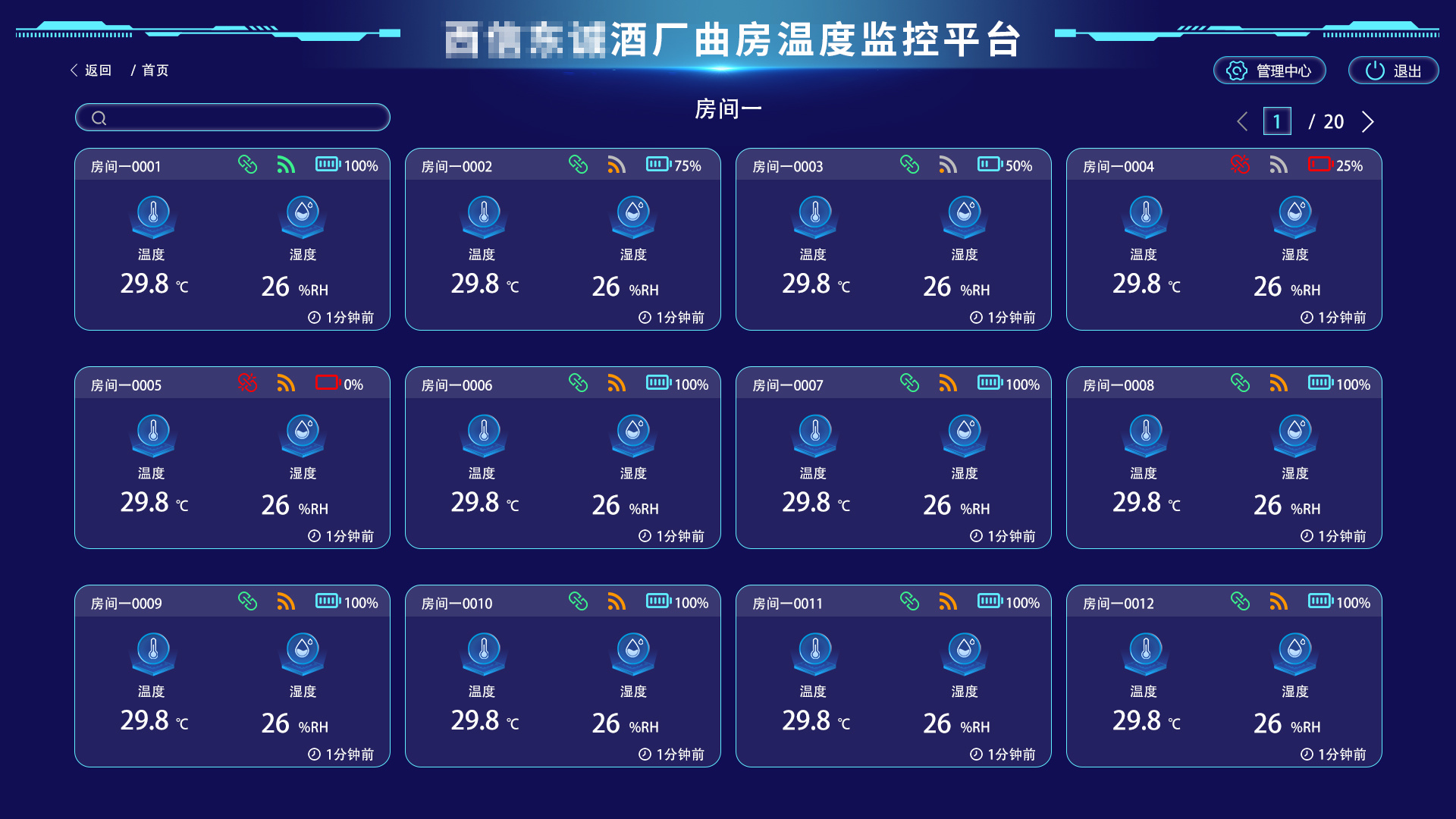
This system platform is an intelligent management hub custom-built for wireless plug-in temperature‑monitoring systems, integrating data storage, analytics, visualization, device management, and alarm integration. It supports access via multiple IoT standard protocols.
It provides a comprehensive user permission management system, enabling digital and intelligent management of the entire temperature‑monitoring process.
- Platform image
III. Application areas
1. Brewing industry
During the baijiu brewing process, particularly in the fermentation stages involving qu and lees, it is essential to monitor the internal temperatures of both the qu and the lees in real time. Temperatures that are too high or too low can adversely affect the quality and yield of the baijiu.
Our company’s wireless plug-in temperature‑monitoring system can track the internal temperature of each batch of fermentation starter and the real-time temperature of the fermented grain mash. The front-end sensors transmit the current temperatures of the starter and the mash to the gateway and alarm terminals via wireless communication every few minutes.
The gateway uploads temperature data to the cloud platform, while the alarm terminal displays the temperature locally and triggers an alert promptly when a temperature anomaly is detected.
2. Tobacco leaf Alcoholization Process
After initial flue-curing, tobacco leaves must undergo a fermentation process, which can be carried out in three different ways, one of which is tobacco leaf aging. , Artificial fermentation , Microbial fermentation:
Tobacco leaf aging
After initial flue-curing, the tobacco leaves are stacked in a temperature- and humidity-controlled warehouse for several months to several years—typically 1 to 3 years. During this period, microbial activity, oxidation reactions, and enzymatic processes gradually break down sugars, proteins, and other compounds, reducing green, off‑flavors and enhancing the aroma.
Monitor the internal temperature of tobacco stacks (typically maintained between 20 and 35°C) to prevent localized overheating, mold growth, or uneven fermentation.
Artificial fermentation
By applying heat (40–60°C), increasing humidity (60%–80%), and employing forced ventilation, the natural aging process can be simulated within a few weeks, thereby shortening the maturation period. This method is commonly used for lower-grade tobacco leaves or in situations requiring expedited production.
Precise temperature control in high-temperature environments is critical, requiring real-time monitoring of the internal temperature of tobacco stacks.
Microbial fermentation
Adding specific microbial strains (such as Bacillus or yeast) or enzyme preparations can selectively degrade macromolecules in tobacco leaves, thereby enhancing smoking flavor. This approach is commonly employed in premium cigarettes and for developing distinctive flavor profiles.
It requires real-time adjustment in accordance with the microbial activity temperature range (e.g., 25–45°C).
Our company’s wireless plug-in temperature‑monitoring system enables real-time tracking of the internal temperature of each tobacco‑leaf stack. The front‑end sensors transmit the stack’s instantaneous temperature via wireless communication to a gateway and an alarm terminal every few minutes. The gateway then uploads the temperature data to a cloud platform, while the alarm terminal displays the readings locally and triggers an alert promptly when temperatures deviate from the norm.
3. The Tea Fermentation Process
During the tea fermentation process, monitoring the internal temperature is essential—indeed, it is even more critical than tracking the surface temperature. This is because it impacts several key aspects, including quality control, fermentation efficiency, and safety management. The following provides a detailed analysis:
1. Fermentation Uniformity and Quality Control
Temperature-sensitive reaction
The core of tea fermentation is enzymatic oxidation—such as the conversion of tea polyphenols catalyzed by polyphenol oxidase—and its activity is highly temperature-dependent:
Optimal range: Black tea fermentation typically requires 25–30°C, while the withering and oxidation stages of oolong tea call for 22–28°C.
Consequences of temperature deviation:
>35°C: Enzyme deactivation accelerates, leading to over-fermentation, a cloudy tea liquor, and a muted aroma (commonly observed when summer tea is piled too thickly).
<20°C: Enzyme activity is insufficient, fermentation stalls, and a grassy aroma remains.
The internal temperature is more accurate.
The temperature difference between the interior and the surface of a tea‑leaf pile or fermentation machine can reach 5–10°C, particularly in large‑scale production; measuring only the surface can lead to misjudgments.
2. Preventing “burning piles” and spoilage (safety prevention and control)
Microbial Out-of-Control Risk
Tea fermentation involves the participation of microorganisms such as yeasts and Aspergillus niger. If the internal temperature remains above 40°C—often due to excessively thick wet piles—:
Harmful bacteria proliferate (such as spoilage bacteria), producing a sour, rancid odor;
The tea leaves have carbonized, rendering the entire batch unusable.
3. Precise control of fermentation degree
Temperature–time synergistic effect
For example, black tea fermentation:
At 28°C, it takes 3–4 hours to achieve the desired reddening of the tea leaves.
If internal temperature measurements reveal that a particular area is only 25°C, you can locally extend the fermentation time or adjust ventilation.
Our company’s wireless plug-in temperature‑monitoring system enables real-time tracking of the internal temperature of fermenting tea leaves. The front-end sensors transmit the in‑process temperature data to a gateway and an alarm terminal via wireless communication every few minutes. The gateway then uploads the temperature data to a cloud platform, while the alarm terminal displays the readings locally and triggers an alert promptly when temperatures deviate from the normal range.
Whether it’s preventing mold in tobacco stacks, avoiding thermal runaway in tea storage, reducing grain losses in granaries, or ensuring quality control in building materials, this system redefines the standard for industrial temperature monitoring with its groundbreaking “one‑probe, multi‑layer” design. It not only overcomes the inefficiencies and limitations of conventional methods but, through the deep integration of IoT technology with real‑world industry applications, drives a leap toward digitalization and intelligent automation in production processes. Looking ahead, as industries increasingly demand more refined management, the wireless plug‑in temperature‑sensing system will continue to help enterprises cut costs, boost efficiency, safeguard quality and ensure safety, becoming a core engine in the field of industrial temperature monitoring.

MORE NEWS
Contact Us
Tel:+86-189-23711266 400-1273-421
E-mail:liulin@rf-md.com
Shenzhen office: 506-509, zone 1, block B, Huayuan science and Technology Innovation Park, No. 168, Baoyuan Road, Xixiang, Bao'an District, Shenzhen
Changsha Branch: 21d, building F4, Lugu enterprise Plaza, No. 27, Wenxuan Road, Yuelu District, Changsha

Follow us
-

E-mail:
yangyalan@rf-md.com
-

Tel:
+86-755-23284193
-
