
New Arrival – Multi-Point Infrared Thermometer
Release time:
2025-03-25
Multi-point infrared thermometer product
Background:
With the intelligent upgrading of power systems, the demand for safety monitoring of distribution cabinets is becoming increasingly prominent. Traditional manual inspections rely on specialized personnel to open cabinets for testing, which is inefficient, costly, and unable to promptly detect localized overheating risks caused by poor contact or overload, posing a fire hazard. In response, our company’s R&D team has focused on infrared sensing and IoT technologies to launch… HYT80 Multi-Point Infrared Thermometer This product employs an 80×62 high‑precision infrared pixel array to enable wide‑range temperature measurement from –20°C to 400°C with an accuracy of ±0.25°C. Coupled with multiple field‑of‑view (FOV) options—45°, 90°, and 105°—and MODBUS protocol compatibility, it provides non‑contact, real‑time monitoring of temperature changes inside distribution cabinets. By transmitting data over a network and leveraging big‑data analytics, it can predict potential risks, delivering an efficient, low‑cost, intelligent solution for power‑grid safety.
I. Product Overview
This product is a next-generation thermometer that integrates infrared array temperature measurement with network transmission. It features rapid infrared array-based temperature sensing, network connectivity, over‑range alarms, and infrared imaging. Equipped with a high‑sensitivity infrared detector and a high‑resolution visible‑light camera, the device can accurately detect temperature changes and precisely measure the temperature of targets in various environments.
The primary application demand for multi-point infrared products stems from temperature monitoring inside distribution cabinets. Due to the large number of interfaces within these cabinets, loose connections or over‑current conditions can easily cause overheating at the contact points, leading to power supply failures and, in severe cases, fires. Moreover, distribution cabinets are specialized equipment that may only be inspected and maintained by qualified electrical personnel; unauthorized access is prohibited, which drives up inspection costs. Infrared array thermography enables real-time internal temperature measurement, enhancing monitoring efficiency while reducing labor expenses and supporting 24/7 continuous surveillance. Additionally, by analyzing collected temperature data alongside peak load periods and thermal trends, big‑data analytics can identify the times and locations most prone to high‑temperature risks, providing an objective basis for proactive management strategies to prevent electrical faults and fires.

-
Product Specifications
2.1 Hardware Specifications
Interface Name |
Specifications |
Explanation |
Power supply |
DC 9~24V |
Wide-voltage power supply, facilitating centralized deployment and control.The power supply interface provides a 3.81 mm plug-in terminal. |
Indicator light |
2 pieces |
1 power indicator light1 system status indicator light |
Button |
1 piece |
Reset button |
Temperature measurement range |
-20℃ ~400℃ |
|
Temperature measurement accuracy |
±0.25℃ |
|
Network port |
1-port 100 Mbps network port |
|
RS485 |
Route 1 |
Standard MODBUS |
Digital output |
Route 1 |
1-channel relay output |
Infrared pixel |
80x62 |
|
Temperature measurement range |
-20℃~400℃ |
|
FOV(H/V/D)° |
45/34/5690/67/122105/79/134 |
The default is 45°, with three specifications available. (H/V/D) stand for horizontal 45°, vertical 34°, and diagonal 56°, respectively. |
PC software |
Save Data |
The software can continuously store the device’s historical data. |
Image Settings |
Image data processing: select a filter, set the infrared emissivity, and configure the alarm threshold. |
|
Nine Major Zone Configurations |
You can draw 1 to 9 regions of interest and view, in real time, the maximum temperature, minimum temperature, and average value for each selected region. |
The model number of this product series is HYT80, and the current hardware version is MI0802M5S.
2.2 Indicator Light Definitions
-
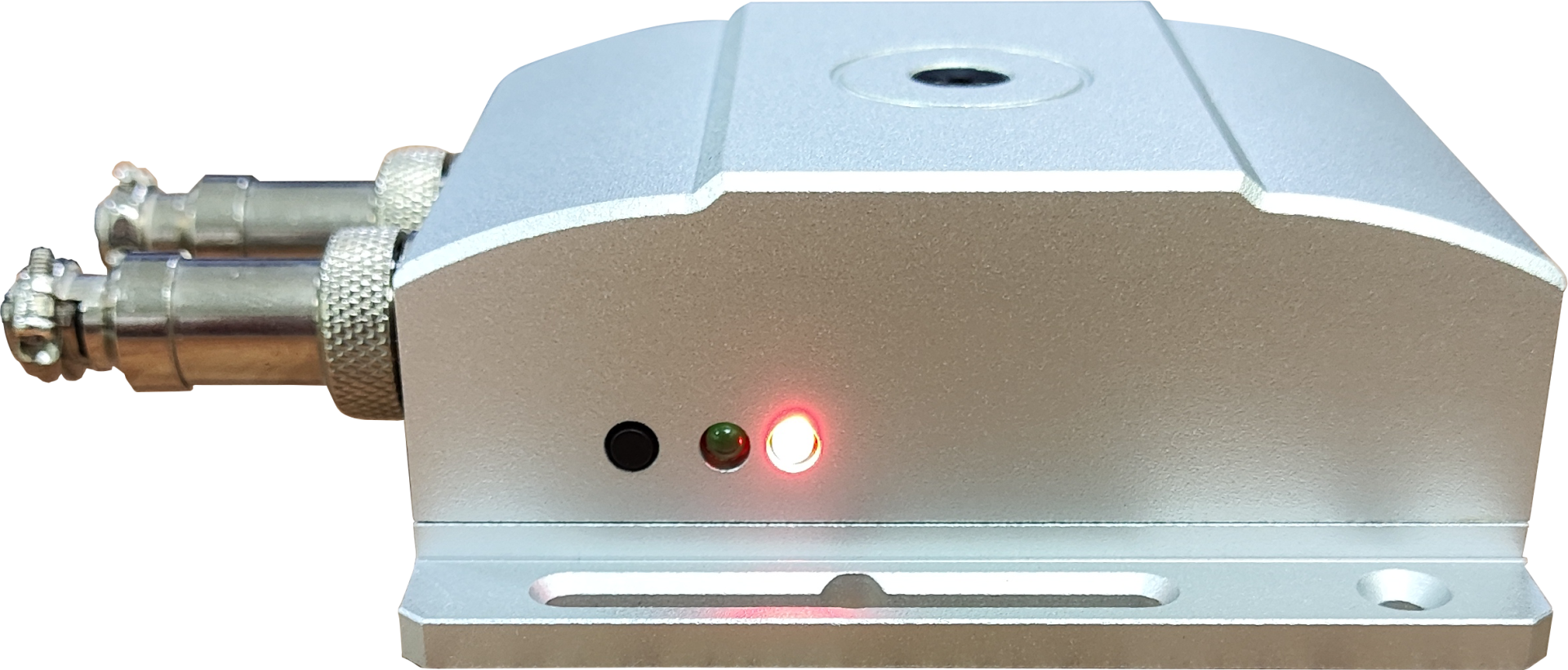
Power indicator light
Red—illuminates when powered, indicating the power supply status.
-
System indicator light
Green; extinguishes during the power-on startup process.
Flashing alternately on and off at a frequency of 1 second indicates normal operation.
A rapid alternating flash at a frequency of 200 ms indicates test mode.
A rapid flash twice, with a 200 ms interval, followed by a 3-second blackout indicates a sensor malfunction.
When the platform/HTTP is enabled, a rapid flash three times at 200 ms intervals, followed by a three-second blackout, indicates a platform connection error.
2.3 Usage Effectiveness
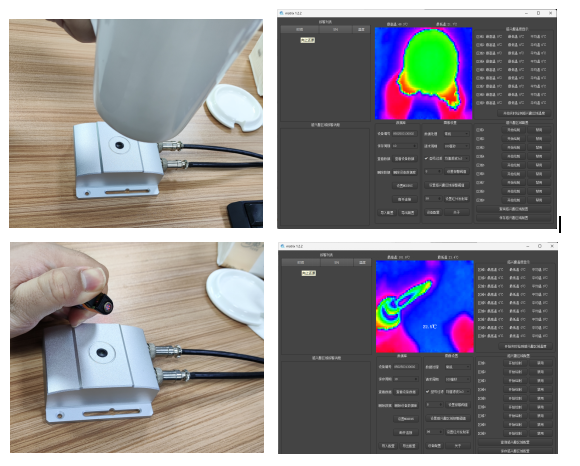
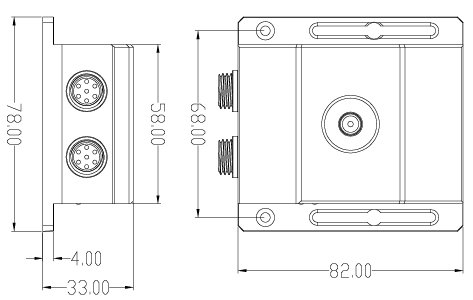
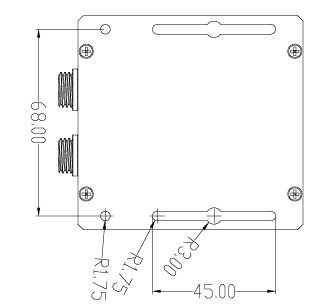
2.4. Product Dimension Diagram
Dimension unit: mm (millimeters)
III. Instructions for Use
3.1 Installation Instructions
-
Based on the measurement requirements and the instrument’s measurement range, select an appropriate installation distance and orientation.
-
Adjust the probe’s measurement direction so that the object being measured is roughly aligned with the observation site.
-
Secure the thermometer.
3.2 PC Tool User Guide
For details, please refer to the “Multi-Point Infrared Temperature Measurement PC Tool User Manual.”
IV. Maintenance and Care
-
During use, if you encounter any malfunctions, please contact the supplier promptly and do not attempt to disassemble or repair the device yourself to avoid accidents.
-
If the device is not used for an extended period, it must be removed and stored in its original packaging in a well-ventilated, dry location.
-
This product is covered by a one-year warranty. During the warranty period, our company shall be liable only for direct damages caused by this product, and the maximum compensation shall not exceed the product’s purchase price. By installing and using this product, you are deemed to have fully understood the meaning of this clause and to have agreed to it.
V. Transportation and Storage
-
During transportation and storage, the original factory packaging and seals must remain intact, and the product must be protected from severe impacts.
-
Ambient temperature should be kept from experiencing drastic fluctuations.
-
The stacking height of packed items shall not exceed six layers, and after unpacking, the stacking height of individual items shall not exceed five layers.
MORE NEWS
Contact Us
Tel:+86-189-23711266 400-1273-421
E-mail:liulin@rf-md.com
Shenzhen office: 506-509, zone 1, block B, Huayuan science and Technology Innovation Park, No. 168, Baoyuan Road, Xixiang, Bao'an District, Shenzhen
Changsha Branch: 21d, building F4, Lugu enterprise Plaza, No. 27, Wenxuan Road, Yuelu District, Changsha

Follow us
-

E-mail:
yangyalan@rf-md.com
-

Tel:
+86-755-23284193
-
