
Can a 60 GHz millimeter-wave radar sensor penetrate glass?
Release time:
2025-03-05
Can 60 GHz millimeter-wave radar penetrate glass? Unveiling the core technologies behind intelligent sensing.
Can 60 GHz millimeter-wave radar penetrate glass? I often see netizens asking me this question, so today I’d like to take it up and discuss it with everyone. The Core Technologies Behind Intelligent Sensing 。
I. The Truth About the Penetration Capability of 60 GHz Millimeter-Wave Radar
1. Physical Characteristics of Millimeter Waves
The wavelength of 60 GHz millimeter waves is approximately 5 mm, classifying them as high-frequency electromagnetic waves. Their energy lies between that of infrared radiation and microwaves, and they exhibit natural penetration through non-metallic materials such as glass and plastic. The dielectric constant of glass—around 6.5 to 7.5—determines its transmission loss; for ordinary single-layer glass, the attenuation typically remains below 5 dB. Means super 80% of the signal can penetrate effectively.
2. The Three Major Factors Affecting Glass Penetration
Material : Ordinary glass has a transmittance greater than 75%, whereas coated glass (such as Low‑E) may experience signal attenuation of more than 50% due to its metallic coating.
Thickness : For every additional 1 mm of thickness, the loss increases by approximately 0.8–1.2 dB.
Angle of incidence : The transmittance is highest at normal incidence, while the signal reflectance increases significantly when the angle exceeds 45°.
Developed by our company 60G Millimeter-wave radar can easily address this issue, as these effects are already mitigated during the early stages of its design.
Additionally We have developed A 60 GHz millimeter-wave radar, equipped with advanced human presence detection technology, not only accurately captures motion and micro‑movement but also sensitively detects stationary humans. At the same time, the radar can dynamically calculate critical ancillary data such as target distance and velocity. This innovative technology is suitable for a wide range of environments—including homes, hotels, offices, and restrooms—enabling real-time, precise detection of human presence within these spaces.
In the security sector, it safeguards your safety by instantly triggering an alarm upon detecting unauthorized intruders. For electrical appliance control, it intelligently turns devices on or off based on occupancy, helping to save energy and boost efficiency. In personnel monitoring, it provides real-time headcount and tracks movement, offering robust support for informed management decisions. Paired with a compatible IoT platform, it enables highly customized, scenario‑specific solutions, empowering industries to elevate their level of intelligence.
II. Technological Breakthrough: How to Achieve Through-Glass Inspection?
1. Multi-band Fusion Technology
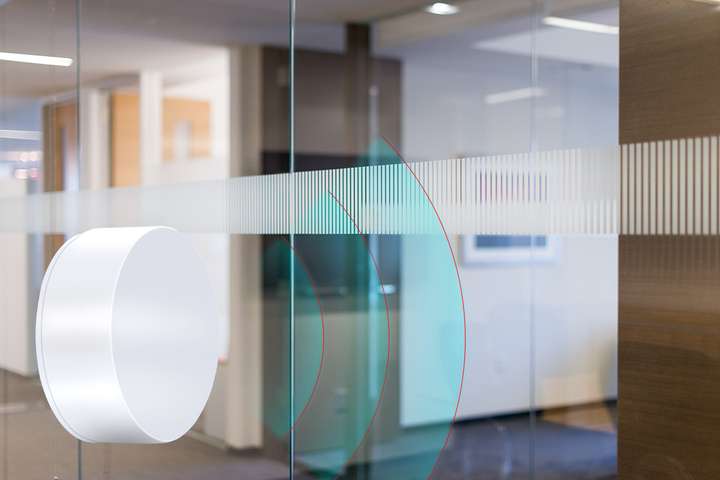
Through The 60 GHz main frequency and the 24 GHz auxiliary band operate in tandem, leveraging AI algorithms to automatically detect glass interfaces, distinguish between penetrating signals and reflective interference, and achieve detection accuracy down to the millimeter level.
2. Anti-Interference Signal Processing
Adopting adaptive filtering techniques, the multipath reflection effects induced on glass surfaces are effectively suppressed. Experimental data indicate that, in… The false alarm rate for detecting human micro-movements through 5 mm-thick glass is less than 0.3%.
3. Typical Application Scenarios
Smart home : Detects human presence through the window, enabling lighting control. /Air conditioner automatic control
Security Surveillance : Detects abnormal movements indoors through glass, addressing privacy concerns associated with traditional cameras.
In-vehicle system : Accurately detects pedestrians through the car window in rainy conditions, enhancing the safety of autonomous driving.
III. Key Parameters in Engineering Practice
 |
|
||
|
|
|||
|
|
|||
|
|
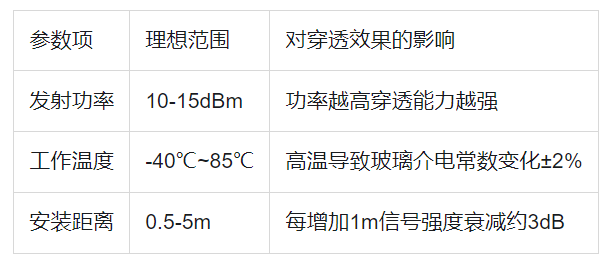
Optimization Recommendations :
1. During installation, ensure the device is positioned at a perpendicular angle to the glass (deviation < 15°)
2. Avoid direct use in applications involving coated glass or laminated glass; a compensation algorithm must be employed.
3. Regularly calibrate temperature and humidity parameters to ensure environmental adaptability.
Conclusion :
60 GHz millimeter-wave radar technology that can penetrate glass is redefining the frontiers of intelligent sensing. With the maturation of domestically developed chip technologies, this capability has been widely adopted in smart home applications, industrial inspection, and other fields.
Future of several In [year], the cost of radar modules with glass-penetrating capabilities is expected to decline. 40%, accelerating the advent of the era of the Internet of Everything.
MORE NEWS
Contact Us
Tel:+86-189-23711266 400-1273-421
E-mail:liulin@rf-md.com
Shenzhen office: 506-509, zone 1, block B, Huayuan science and Technology Innovation Park, No. 168, Baoyuan Road, Xixiang, Bao'an District, Shenzhen
Changsha Branch: 21d, building F4, Lugu enterprise Plaza, No. 27, Wenxuan Road, Yuelu District, Changsha

Follow us
-

E-mail:
yangyalan@rf-md.com
-

Tel:
+86-755-23284193
-
