
Application of Wireless Plug-in Thermometers in Grain Silo Monitoring
Release time:
2025-08-29
Application of Wireless Plug-in Thermometers in Grain Silo Monitoring
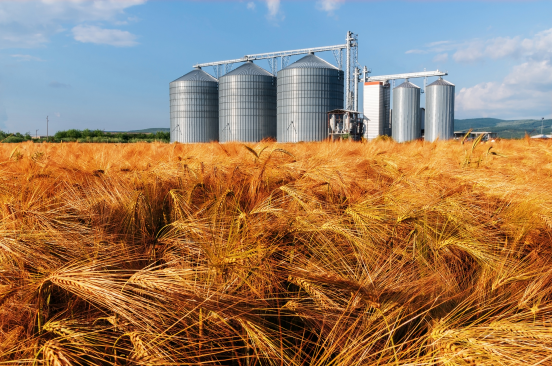
Food security is a vital component of national security, and granaries, as critical facilities for grain storage, require particularly robust real-time monitoring of their internal environmental parameters. Temperature is one of the key factors affecting grain‑storage quality; improper temperature fluctuations can lead to mold growth, spoilage, or even fires. Conventional manual inspection methods are not only inefficient but also suffer from monitoring blind spots and safety risks. With the advancement of IoT technology, wireless plug‑in thermometers have increasingly emerged as effective tools for granary temperature monitoring.
Challenges in Granary Temperature Monitoring
Granaries feature complex environments and deep grain stacks, resulting in often uneven internal temperature distributions and significant temperature differences between layers. Manual inspections typically yield temperature data only from the surface or a few discrete points, making it difficult to accurately capture the full picture of conditions inside the granary. Moreover, granaries are often widely dispersed and operate in harsh environments, where wired monitoring systems face challenges such as difficult cabling, high maintenance costs, and susceptibility to environmental factors. Consequently, establishing efficient, comprehensive, and reliable temperature monitoring has become an urgent priority for granary management. 
Working principle of the wireless plug-in thermometer
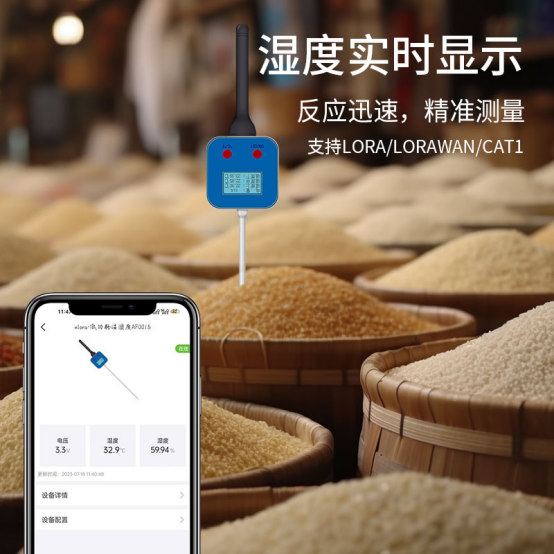
The wireless insertion-type thermometer employs a high-precision temperature sensor and uses an insertable probe to measure temperatures directly within the grain, enabling real-time monitoring at multiple depths. The device features a low-power design and transmits collected data wirelessly to a gateway, which then uploads the information to a cloud platform or a local monitoring system. Users can access temperature data anytime via a computer or mobile device, allowing them to promptly detect any anomalies.
Such devices typically feature multi-channel temperature measurement capabilities, enabling simultaneous monitoring of multiple points and providing a comprehensive understanding of the three-dimensional, multi-layered temperature distribution within grain storage facilities. Their aluminum alloy enclosures are not only lightweight and flame-retardant but also offer excellent durability and strong resistance to electromagnetic interference, making them suitable for a wide range of challenging environments.
Specific application methods in grain storage facilities
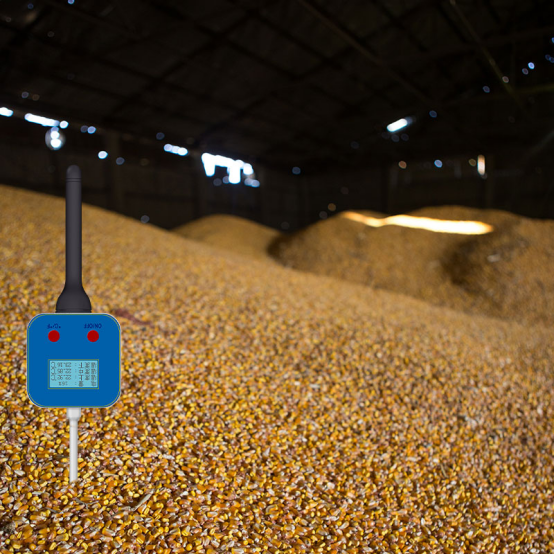
The application of wireless plug-in thermometers in grain storage facilities is primarily reflected in the following aspects:
1. Hierarchical Monitoring The internal temperature of a grain pile often exhibits stratified variations. The equipment can simultaneously monitor temperatures at multiple layers—upper, middle, and lower—enabling managers to assess the overall thermal condition of the pile and promptly identify localized areas of overheating or moisture buildup.


2. Wireless Networking : A wireless sensor network is established using multiple temperature‑sensing nodes, covering the entire grain storage area to enable comprehensive, dead‑zone‑free monitoring of large‑scale grain piles. The gateway device aggregates the data and transmits it to the monitoring center, allowing remote real-time viewing and alarm notification.
3. Data Visualization Monitoring data can be visualized on the platform, generating temperature‑change curves and distribution maps to support managers in analysis and decision‑making, thereby enhancing the scientific rigor and accuracy of grain‑storage management.
4. Early Warning and Prevention The system allows users to set temperature thresholds; when an abnormal temperature rise is detected, it immediately issues an alert, prompting management personnel to promptly implement ventilation, grain turning, or other measures to prevent spoilage or spontaneous combustion.
Technological Advantages and Value
Compared with traditional temperature‑measurement methods, wireless insertion thermometers offer distinct advantages:
- Strong real-time performance : Data is automatically uploaded without manual intervention, enabling round-the-clock continuous monitoring.
- Easy to install : The plug-in design is suitable for a variety of grain-storage environments, eliminating the need for complex wiring and reducing installation and maintenance costs.
- Low power consumption, long battery life : Suitable for long-term monitoring tasks, reducing the need for frequent battery replacements.
- High precision and reliability : Industrial-grade sensors ensure data accuracy and stability, making them suitable for critical environments such as grain silos.
Conclusion
The application of wireless plug-in thermometers offers an efficient and reliable solution for temperature monitoring in grain storage facilities, aligning with the modern demands for intelligent and automated warehouse management. By enabling real-time, multi-point temperature data collection and analysis, this technology not only enhances the safety of grain storage but also provides critical technical support for the digital transformation of the grain industry. As IoT, artificial intelligence, and other technologies continue to converge, future grain‑storage management will become even smarter, more efficient, and more dependable.
MORE NEWS
Contact Us
Tel:+86-189-23711266 400-1273-421
E-mail:liulin@rf-md.com
Shenzhen office: 506-509, zone 1, block B, Huayuan science and Technology Innovation Park, No. 168, Baoyuan Road, Xixiang, Bao'an District, Shenzhen
Changsha Branch: 21d, building F4, Lugu enterprise Plaza, No. 27, Wenxuan Road, Yuelu District, Changsha

Follow us
-

E-mail:
yangyalan@rf-md.com
-

Tel:
+86-755-23284193
-
