
Is the source of bathroom odors hard to detect? This sensor accurately identifies and alerts you to it.
Release time:
2025-09-04
Solving the Challenge of Environmental Odors: Applications of Multi-Parameter Gas Monitoring Technology
In the environmental management of numerous public spaces—such as smart restrooms, smart buildings, smart libraries, and smart hospitals—subtle changes in air quality directly impact both user experience and health. Among these, odor issues in restrooms are particularly pronounced, with complex sources that traditional methods often fail to pinpoint quickly and accurately. Relying solely on ventilation or the use of air fresheners merely masks odors temporarily, without addressing the root cause.
Odors typically arise from a mixture of various gases; for example, hydrogen sulfide (H₂S) has the characteristic smell of rotten eggs, while ammonia (NH₃) is highly irritating. These gases are not only unpleasant but can also adversely affect indoor air quality at elevated concentrations. Therefore, effective odor management begins with accurately identifying their composition and monitoring concentration changes, thereby providing reliable data to support environmental control measures.
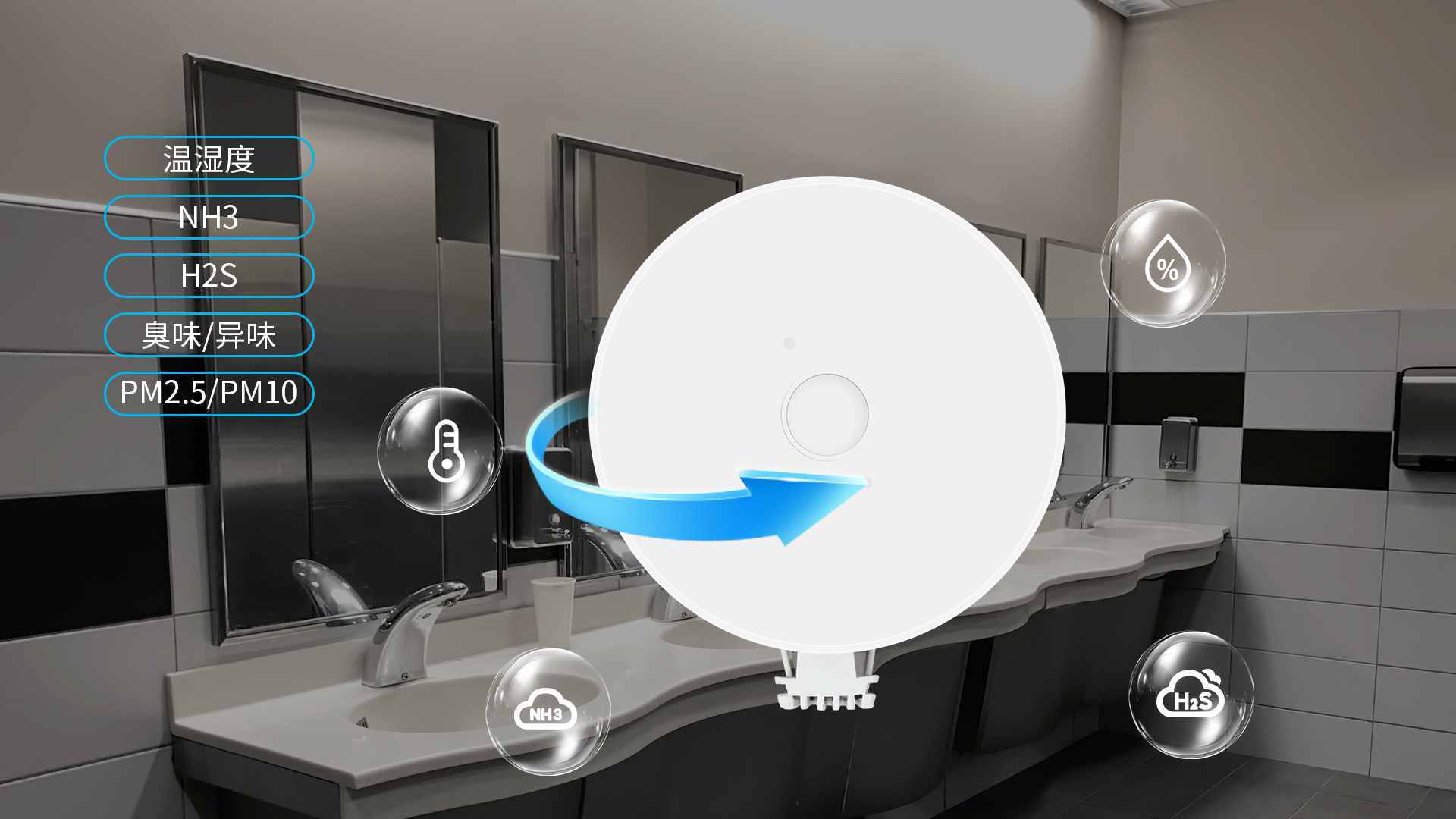
With the advancement of IoT sensing technologies, addressing this challenge has become feasible. Environmental monitoring devices integrating multiple high-precision sensors have emerged. These devices typically measure a range of gases—including hydrogen sulfide and ammonia—alongside environmental parameters such as temperature, humidity, and particulate matter (PM2.5, PM10). By collecting multidimensional data, they provide a comprehensive picture of air quality in a given space.
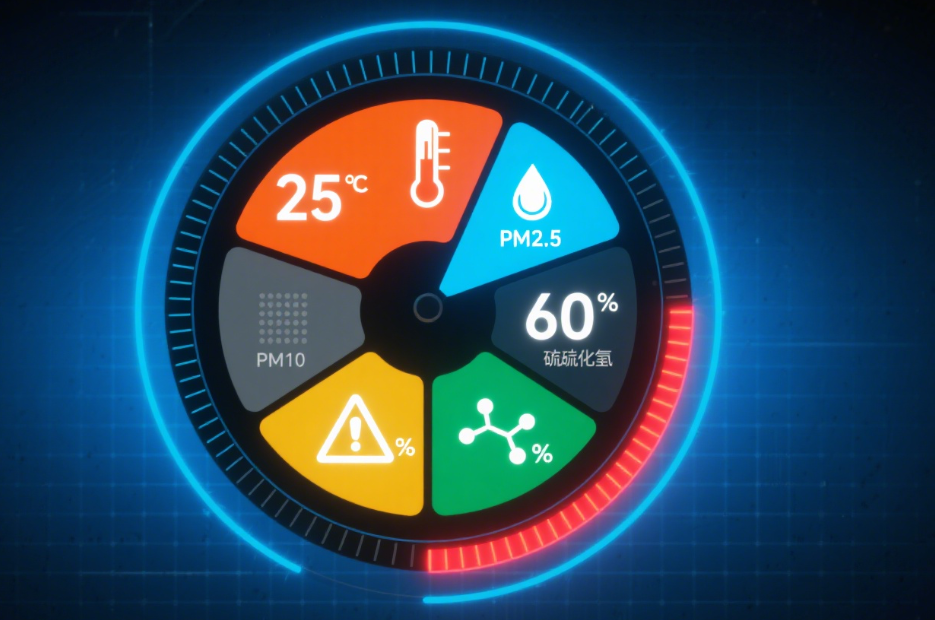
The core of such environmental monitoring devices lies in the sensing technologies they employ. For instance, to detect hydrogen sulfide and ammonia, these devices are typically equipped with electrochemical sensors, which offer high sensitivity, fine resolution, and excellent stability, enabling effective detection of low‑concentration gases. Meanwhile, temperature and humidity sensors, particulate matter sensors, and other components work in concert to form a comprehensive network for monitoring environmental parameters.
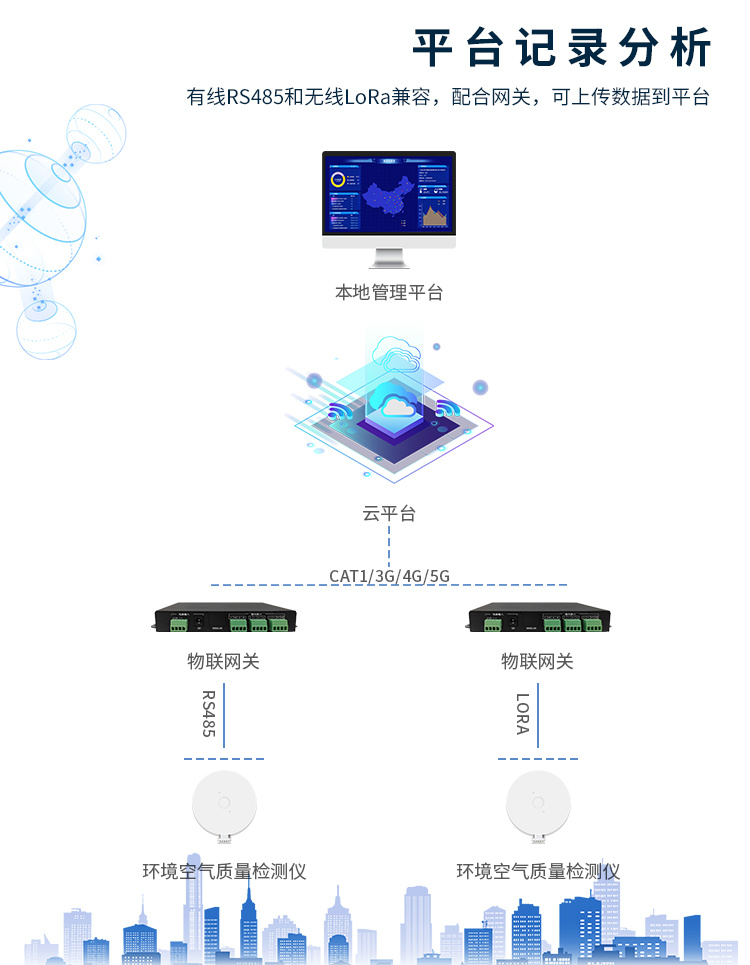
In addition to precise sensing capabilities, reliable data transmission is equally critical. Currently, mainstream devices support wired RS‑485 communication and are also compatible with low‑power wide‑area IoT technologies such as wireless LoRa and LoRaWAN. Through the standardized Modbus protocol, these devices can be easily integrated into existing building automation systems or IoT platforms. Once data is uploaded to the cloud, it can undergo further analysis, recording, and trend forecasting, providing decision‑making support for managers.
In real-world deployments, this type of device, with its integrated design and compact footprint, is ideally suited for ceiling‑mount installation, seamlessly blending into diverse indoor settings without appearing obtrusive. Its operating status is clearly indicated by status LEDs, facilitating routine monitoring and maintenance. Its broad range of applications underscores its value: in smart restrooms, it provides real-time detection of odorous gases and triggers the ventilation system; in smart libraries and hospitals, it helps maintain a quiet, healthy air environment; and in smart hotels and commercial buildings, it serves as an essential component in delivering a comfortable guest experience.
More importantly, this data‑driven monitoring approach has shifted away from the previous reactive model. By continuously tracking environmental parameters, the system can detect abnormal changes at an early stage—before odors become noticeably perceptible—and issue timely alerts, enabling more proactive and precise environmental interventions. This not only enhances management efficiency but also fundamentally improves the livability of the space.
From a technical standpoint, ensuring the long-term stability and data accuracy of sensors is of paramount importance. High‑quality products typically exhibit meticulous component selection, with both the main control MCU and the sensors designed for robust reliability. The device must also operate reliably across a wide range of environmental conditions, and a broad‑range power‑supply design further enhances its adaptability to diverse application scenarios.
In short, when confronted with complex environmental odor issues, relying solely on human olfaction or experience can no longer meet the demands of modern smart‑space management. Integrated environmental monitoring technologies, by capturing precise, real‑time, multi‑dimensional data, transform invisible environmental factors into quantifiable, manageable metrics. These systems are not only tools for environmental management but also powerful enablers for elevating public health and environmental quality to new heights. By leveraging technology to sense and understand the environment, we can ultimately create healthier, more comfortable living and working spaces in a more scientifically grounded way.
MORE NEWS
Contact Us
Tel:+86-189-23711266 400-1273-421
E-mail:liulin@rf-md.com
Shenzhen office: 506-509, zone 1, block B, Huayuan science and Technology Innovation Park, No. 168, Baoyuan Road, Xixiang, Bao'an District, Shenzhen
Changsha Branch: 21d, building F4, Lugu enterprise Plaza, No. 27, Wenxuan Road, Yuelu District, Changsha

Follow us
-

E-mail:
yangyalan@rf-md.com
-

Tel:
+86-755-23284193
-
