
Is the risk of water leaks hard to detect? Water‑infiltration sensors help enable precise prevention and control.
Release time:
2025-09-05
Is the risk of water leaks hard to detect? Water‑infiltration sensors help enable precise prevention and control.
Leakage risks are often highly concealed, and by the time they are detected, irreversible damage has already occurred. Consequently, achieving early, precise prevention and control has become paramount. Water immersion sensor Real-time monitoring based on the principle of liquid conductivity provides an efficient and reliable solution, suitable for a wide range of critical infrastructure environments, thereby effectively safeguarding asset security.
Is the risk of water leaks hard to detect? Water‑infiltration sensors help enable precise prevention and control.
In daily operations and facility management, water leaks are an unpredictable yet potentially severe hazard. Whether in data centers, telecommunications rooms, warehouses, or archives, the risk of water damage is ever-present. Conventional manual inspections cannot provide round-the-clock coverage, and even minor leaks can go unnoticed—by the time they’re detected, it’s often too late. Consequently, how to achieve early warning and precise preventive measures has become a key priority for many organizations. Water‑infiltration sensors are a reliable technological solution specifically designed to address this challenge.

I. Operating Principle and Key Features of the Water Immersion Sensor
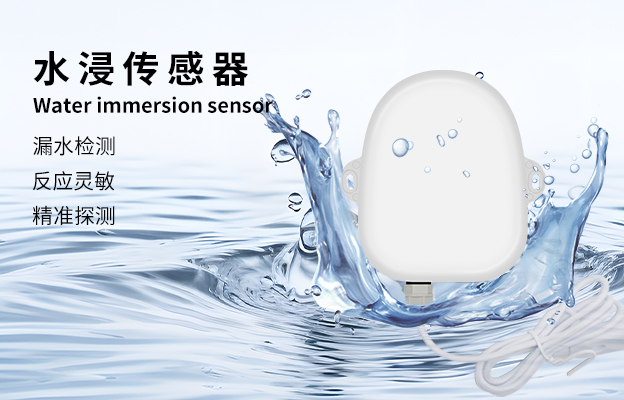
Water‑infiltration sensors are contact‑type detection devices that operate on the principle of liquid conductivity. When the sensor probe comes into contact with water or other conductive liquids, the circuit closes, activating the alarm and transmitting real‑time alerts. This approach offers rapid response and high reliability, enabling timely warnings and allowing operators to take immediate corrective action.
This type of sensor uses an industrial-grade chip as its main control unit, offering excellent stability and strong anti-interference performance. The device features a compact overall design, with an ABS‑material housing that meets IP67 protection standards, providing dustproof and waterproof capabilities for long-lasting durability. Additionally, the sensor supports a low‑power operating mode, with a quiescent current below 5 µA; its built-in battery can sustain 2–3 years of continuous operation, eliminating the need for frequent power replacements and removing the hassle of wiring.
II. Main Technical Parameters and Performance Advantages
From a technical standpoint, water‑infiltration sensors offer numerous application advantages. Their sensing range can be flexibly configured to meet specific requirements, supporting monitoring over distances of up to 500 meters and covering a wide area. The device supports multiple communication protocols, including LoRa, LoRaWAN, and Cat.1, allowing users to select the most suitable solution based on their existing network infrastructure and achieve seamless data integration.
Wireless transmission is another key highlight. The sensors feature a built-in antenna, making installation quick and easy without the need for additional wiring, which significantly reduces deployment complexity and retrofitting costs. In terms of communication, LoRa and LoRaWAN modes support transmission distances of up to 5,000 meters in open environments, offering robust penetration and wide‑area coverage—ideal for large‑scale, multi‑room settings.

The device also features a low‑battery alert, providing early warnings of insufficient power to prevent monitoring blind spots. Its operating temperature range spans –10°C to 60°C, accommodating most indoor and outdoor conditions and ensuring stable performance across diverse climates.
III. Analysis of Applicable Scenarios
Water‑infiltration sensors are widely suited for environments with stringent waterproofing and leak‑prevention requirements. Data centers, server rooms, and similar facilities house large quantities of costly electronic equipment that is highly sensitive to humidity; even a minor water leak can result in data loss or hardware damage, making continuous water‑infiltration monitoring indispensable.
Power plants, distribution substations, and other electrical facilities must also be protected against water ingress to prevent short circuits and safety incidents. In warehouses and archives, critical supplies and documentary records are highly susceptible to water damage; water‑invasion sensors provide continuous 24‑hour monitoring, effectively mitigating associated risks.
In addition, this device can be deployed in commercial buildings, underground spaces, laboratories, and other environments, helping to establish a more comprehensive security‑monitoring system. Its versatile mounting options—wall‑mounting and rail‑mounting—further enhance its adaptability and flexibility.
IV. Usage and Maintenance Recommendations
Water‑infiltration sensors are designed with user convenience in mind; once installed and powered on, they typically enter operational mode without requiring complex calibration. During routine use, it is recommended to periodically inspect the device for any visible damage and ensure the probe remains clean, to prevent dust or foreign particles from compromising detection accuracy.
If the device malfunctions, we recommend contacting a qualified technician to avoid further damage caused by attempting self-repair. If the device will remain unused for an extended period, we suggest removing it from its components and storing it in its original packaging in a well-ventilated, dry environment. During transportation and storage, please avoid severe impacts and abrupt changes in temperature or humidity to ensure stable product performance.

V. Technological Development Trends and Prospects
As the Internet of Things and wireless communication technologies continue to advance, water‑infiltration monitoring devices are undergoing ongoing optimization. Higher integration, lower power consumption, and broader protocol compatibility will define the direction of future product iterations. Meanwhile, integrating these devices with cloud platforms and AI algorithms holds the promise of more intelligent risk prediction and automated alert coordination, paving the way for a more efficient water‑safety protection system.
Conclusion
Faced with hidden yet highly damaging water leakage risks, Water immersion sensor With its real-time responsiveness, stability and reliability, and ease of installation, it has become an effective technological safeguard. In a variety of critical infrastructure settings, it provides continuous monitoring and instant alerts, helping to minimize losses caused by flooding and enhancing overall safety management.
MORE NEWS
Contact Us
Tel:+86-189-23711266 400-1273-421
E-mail:liulin@rf-md.com
Shenzhen office: 506-509, zone 1, block B, Huayuan science and Technology Innovation Park, No. 168, Baoyuan Road, Xixiang, Bao'an District, Shenzhen
Changsha Branch: 21d, building F4, Lugu enterprise Plaza, No. 27, Wenxuan Road, Yuelu District, Changsha

Follow us
-

E-mail:
yangyalan@rf-md.com
-

Tel:
+86-755-23284193
-
