
This article explains how to use millimeter-wave radar level gauges to accurately measure water levels during the heavy-rain flood season.
Release time:
2025-09-16
This article explains how to use millimeter-wave radar level gauges to accurately measure water levels during the heavy‑rain flood season.
During the heavy‑rain flood season, water‑level monitoring faces numerous challenges. How can millimeter‑wave radar level gauges achieve precise measurements? The heavy‑rain flood season poses a severe test for water‑level monitoring equipment. Strong winds, torrential rain, waves, floating debris, and rapidly fluctuating water levels all present significant challenges to conventional measurement methods. However, millimeter‑wave radar level gauges, with their unique technological advantages, are ideally suited to deliver outstanding performance even under such extreme conditions. This article will provide an in-depth analysis of how these devices achieve stable, high‑precision water‑level measurements in the complex environments of the flood season.
I. Confronting the Challenges of Heavy Rain: The Technological Confidence of Millimeter-Wave Radar
Traditional contact‑type measurement methods, such as float‑type and pressure‑type sensors, are highly susceptible to entanglement or blockage by floating debris during flood seasons, leading to data distortion or even equipment damage. Meanwhile, in non‑contact measurements, ultrasonic level gauges may suffer from inaccurate readings due to substantial noise interference caused by extreme temperature gradients, strong winds, or heavy rainfall itself.
Millimeter-wave radar level gauges (typically operating at frequencies of 76–81 GHz) inherently circumvent these issues:
Strong anti-interference capability Millimeter waves have extremely short wavelengths, enabling them to penetrate media such as rain, fog, and dust. They also offer superior focusing capability and narrower beamwidths. This means that even in heavy downpours, radar waves can effectively penetrate the rain curtain and maintain a firm “lock” on the water surface, unaffected by the strong reflections from raindrops themselves, thereby ensuring the clarity and stability of the echo signal.
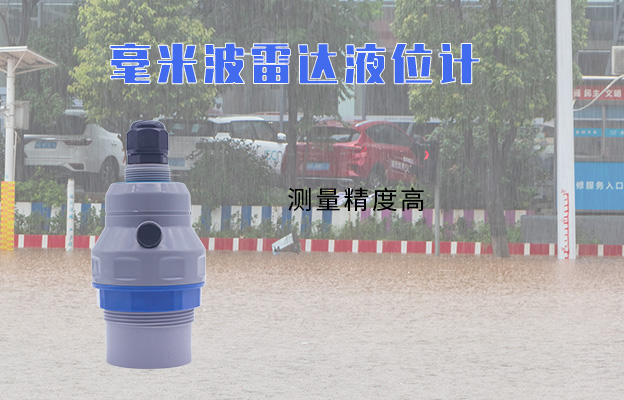
High precision and small blind spot As specified in the datasheet, its measurement accuracy reaches ±5 mm, with a resolution of 1 mm. This is critical for monitoring subtle, rapid changes in water levels during flood seasons. A blind zone of less than 14 cm also allows it to be installed closer to the water surface, enabling it to handle situations where water levels rise sharply and approach the sensor.
True non-contact measurement : The equipment does not come into contact with water, completely eliminating the risk of being washed away by floodwaters or damaged by floating debris, thereby ensuring its survivability and continuous operational capability during the flood season.
II. Deployment and Application: Ensuring Fail-Safe Monitoring During the Flood Season
Having good equipment alone is not enough; proper deployment and application are key to maximizing its performance. In light of the installation requirements outlined in the product specification, the following considerations should be observed during the flood season:
Optimal Installation Location : The instrument must be ensured. Perpendicular to the water surface The installation location should be selected, whenever possible, in an area with steady flow, minimal surface turbulence, and away from vortices and spillway outlets. Additionally, ensure that the radar beam’s field of view—25° horizontally by 15° vertically—is free of fixed obstructions, such as bridge piers or quay‑side railings, to prevent the generation of false echoes.
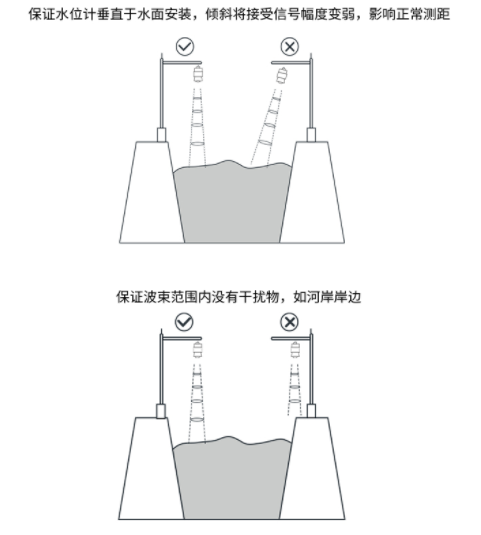
Addressing Wellbore Conditions : In the monitoring of urban underground utility networks and manholes, equipment should be installed as close as possible to the center of the well shaft, and At least 20 cm from the side wall. , thereby minimizing interference caused by wellbore wall reflections and ensuring that the measured value represents the true water level rather than the distance to the wellbore wall.
Stable installation During the flood season, strong winds are common; therefore, a robust mounting bracket or threaded installation must be used to ensure that the equipment remains stable and does not sway or tilt in wind and rain, thereby maintaining the measurement reference.
III. Beyond Measurement: Building an Intelligent Early-Warning System for the Flood Season
The value of millimeter-wave radar level gauges lies not only in their accuracy but also in their practicality. Their diverse data‑transmission options provide the core data foundation for building intelligent flood‑season early‑warning systems:
Multiple communication methods : As stated in the specification, the device supports LORA, LORAWAN, 4G (CAT1), and RS485 and various other communication methods. During the flood season, wireless transmission offers distinct advantages: it requires no cabling and allows for flexible deployment. Even in remote field locations where power is unavailable, the equipment can rely on solar power combined with 4G or LoRa to transmit critical data to the monitoring center in real time.
Real-time remote monitoring and alerting : Managers can access the platform without needing to be on-site. Real-time water level data query . More importantly, it can Remotely set alarm thresholds (For example, setting alert levels, guaranteed levels, and emergency levels.) Once the water level exceeds the threshold, the device can immediately transmit alarm information via a 4G/LORA network and trigger a relay‑output digital signal, activating alarms, gates, or other control systems to enable rapid response.
Resumable Uploads and Reliability : The 4G version features a “disconnected‑network logging” function. Even during severe rainstorms when network connectivity is extremely poor, the device stores collected data locally and automatically resends it as soon as the network is restored, effectively preventing the loss of critical data and ensuring data integrity.
During this natural “major test” of the heavy-rain flood season, millimeter-wave radar level gauges, with their… Strong anti-interference capability, high measurement accuracy, non-contact, safe and reliable. and core technological advantages, as well as Flexible networking, intelligent early warning Its application capabilities provide the optimal solution for precise water-level measurement. It serves not only as the “eyes” for acquiring water-level data but also as an indispensable “sensory nerve ending” in the construction of smart water‑management systems and intelligent early‑warning systems for urban flood control and drainage, offering a robust data foundation for disaster prevention and mitigation decision‑making and helping to ensure safety during the flood season.
MORE NEWS
Contact Us
Tel:+86-189-23711266 400-1273-421
E-mail:liulin@rf-md.com
Shenzhen office: 506-509, zone 1, block B, Huayuan science and Technology Innovation Park, No. 168, Baoyuan Road, Xixiang, Bao'an District, Shenzhen
Changsha Branch: 21d, building F4, Lugu enterprise Plaza, No. 27, Wenxuan Road, Yuelu District, Changsha
Follow us
-

E-mail:
yangyalan@rf-md.com
-

Tel:
+86-755-23284193
-
