
Is your industrial workshop large and sprawling? 4G temperature‑sensing sensors: measure multiple locations simultaneously, with data displayed centrally.
Release time:
2025-10-11
Is your industrial workshop large and sprawling? 4G temperature‑sensing sensors: measure multiple locations simultaneously, with data displayed centrally.
Abstract:
Faced with the challenge of temperature monitoring in large industrial workshops with dispersed equipment, 4G temperature sensors demonstrate significant advantages. By leveraging wireless networking, they can simultaneously track temperatures at dozens of measurement points and, via the 4G network, transmit data in real time to a centralized platform, enabling unified monitoring and management across regions and devices. This provides robust support for industrial safety and efficient operations and maintenance.
In the industrial manufacturing sector, production workshops are typically spacious, with equipment distributed across wide areas. The temperature of components such as distribution cabinets, motor bearings, and critical nodes along production lines directly impacts both operational safety and equipment lifespan. Conventional temperature‑monitoring methods rely on manual inspections, which are not only inefficient and fail to promptly detect latent thermal hazards, but also cannot provide continuous data recording or centralized analysis.

This industry pain point is being effectively addressed as 4G temperature-sensing sensors become widely adopted.
I. Workshop Temperature Measurement: What Challenges Does the Traditional Approach Face?
Temperature monitoring in industrial environments often faces three major practical challenges:
Scattered deployment locations and challenging wiring: The workshop environment is characterized by high temperature, high pressure, and strong electromagnetic interference, making cable installation for sensors costly, difficult, and inflexible.
Data silos prevent integration: Temperature data from individual devices and areas exist in isolation, creating “information islands” that make it difficult to gain a holistic view of the workshop’s thermal conditions.
Response delays and inadequate early warnings: Manual inspections suffer from time‑based blind spots and cannot provide continuous 24/7 monitoring, resulting in untimely alerts and the potential loss of the optimal window for intervention.
These challenges have made a temperature‑monitoring solution that enables wireless transmission, multi‑point synchronization, and centralized management an essential requirement.
II. 4G Temperature-Sensing Sensors: How to Achieve “Decentralized Monitoring, Centralized Management”?
The 4G temperature-sensing sensor is not an isolated component, but rather a systematic solution. Its core operating mode is as follows:
Front-end sensing and wireless networking: Multiple wireless temperature sensors are deployed at critical locations such as distribution cabinets, production lines, and motor equipment. These sensors typically leverage low-power local-area network technologies like LoRa to establish front-end networks, effectively addressing the challenges of wiring in complex environments.
The wireless temperature‑monitoring terminal offers a rich array of interfaces: internally, it supports wireless communication (LoRa/LoRaWAN), wired RS‑485, and I/O; it can connect to a wide variety of wired and wireless sensors, enabling the formation of compact systems with diverse sensor types. Externally, it supports 4G/5G and RJ45, allowing it to upload collected sensor data to a cloud platform, and it can also use its I/O ports to interface with external control devices. Below are some example system configurations featuring this wireless temperature‑monitoring terminal.
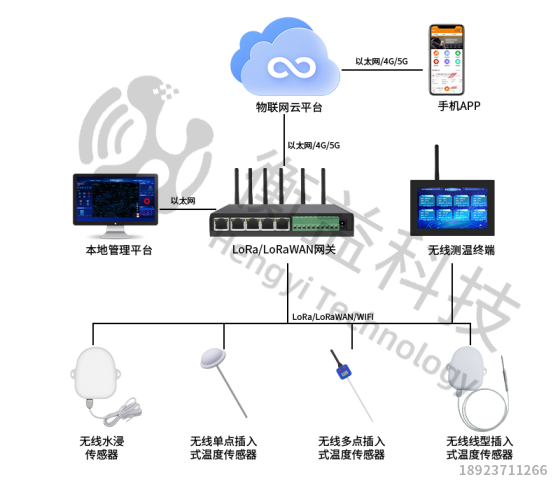
Data aggregation and 4G remote transmission: Sensor data is collected by a nearby wireless temperature‑monitoring terminal. This terminal is equipped with an integrated 4G module, serving as a data relay that transmits temperature readings from multiple sensors within the local area to the cloud‑based management platform in real time via the extensive 4G network.
Cloud‑based aggregation, unified dashboard: All data uploaded from different workshops and areas is consolidated on the cloud platform. Regardless of location, managers can simply log in via computer or mobile device to view real-time temperatures, historical trends, and alarm statuses for all monitoring points simultaneously.
This “sensor layer–aggregation layer–platform layer” architecture perfectly achieves the management objective of “simultaneous multi-point measurement and centralized data visualization.”
III. Core Technological Advantages of the 4G Temperature Measurement Solution
Wide Coverage and Flexibility: With its extensive signal coverage, the 4G network enables the temperature‑monitoring system to be easily deployed in large workshops with complex signal environments, across multiple plant sites, or even at remote stations, without being constrained by geographical distance or cabling requirements.
High Concurrency and Real-Time Performance: Supports multi-channel sensor connectivity, enabling a single terminal to manage 16 or more temperature measurement points simultaneously and upload all data in parallel, thereby ensuring data integrity and real-time responsiveness.
Large-capacity local storage: As a data aggregation hub, the wireless temperature‑monitoring terminal typically features ample local storage—such as 4G eMMC—ensuring no data is lost during brief network outages and enabling the retention of up to ten years of historical data, thereby providing a robust data foundation for trend analysis and predictive maintenance.

Robust environmental adaptability: Featuring a professional industrial‑grade design, these sensors and terminals operate across a wide temperature range of –30°C to 65°C and offer excellent dust‑ and moisture‑resistance, enabling reliable performance in the harsh conditions of industrial workshops.
IV. The Practical Value Brought to Industrial Workshops
Enhance safety: Implement continuous temperature monitoring of heat‑prone equipment such as switchgear contacts, cable joints, and motors; trigger an immediate alarm upon overheating, thereby nipping fires and other safety incidents in the bud.
Optimizing the operations and maintenance model: shifting from “reactive emergency repairs” to “proactive early warning,” and from “manual inspections” to “automated monitoring,” thereby significantly reducing the workload and safety risks for O&M personnel while enhancing operational efficiency.
Decision‑Support Analytics: The platform’s long-term historical data can be used to analyze equipment load variations, aging trends, and their correlation with temperature, providing data‑driven insights to inform equipment upgrades, process optimization, and energy‑saving initiatives.
Achieve centralized control: Group- or plant-level managers can instantly grasp the operational health of all equipment across the entire facility, enabling unified, standardized management across workshops and regions and enhancing overall management efficiency.
Shenzhen Hengyi Technology’s wireless temperature‑monitoring system integrates data acquisition, storage, display, transmission, and automated control into a single solution. It is widely used across various industries: in the industrial sector—monitoring equipment temperatures at electrical‑equipment manufacturers and in production workshops; in cold‑chain and hazardous‑chemical warehousing to ensure cargo safety; by property‑management and environmental‑protection agencies for environmental monitoring; in agricultural greenhouses and livestock farms to regulate growing conditions; in data centers, transportation hubs, and communication base stations for equipment maintenance; and in hospitals for managing pharmaceutical storage and ward environments. The system intelligently links with temperature‑control and ventilation devices, reducing costs while boosting efficiency and safeguarding safety. Powered by a 1.2 GHz high‑speed CPU and backed by over ten years of data retention, it features a 10.1‑inch high‑precision capacitive touchscreen for intuitive operation, and supports Ethernet, 4G, and 5G connectivity for cloud‑based data upload and mobile app access, enabling real‑time visualization and full traceability of measurement data.
MORE NEWS
Contact Us
Tel:+86-189-23711266 400-1273-421
E-mail:liulin@rf-md.com
Shenzhen office: 506-509, zone 1, block B, Huayuan science and Technology Innovation Park, No. 168, Baoyuan Road, Xixiang, Bao'an District, Shenzhen
Changsha Branch: 21d, building F4, Lugu enterprise Plaza, No. 27, Wenxuan Road, Yuelu District, Changsha

Follow us
-

E-mail:
yangyalan@rf-md.com
-

Tel:
+86-755-23284193
-
