

Selection and Support

IoT Gateway: The “Neural Center” for Building a Smart Ecosystem
An analysis of the role of edge computing gateways in smart cities, their industrial‑grade design, real‑world application cases, and future development trends reveals that IoT gateways, as the “neural center” of the smart ecosystem, are assuming an increasingly pivotal role in modern urban and industrial systems. As technology continues to advance, IoT gateways are poised to play an even more significant part in the smart world of tomorrow.
2025/02/11

Millimeter-Wave Radar: Unlocking the Unlimited Potential of Smart Homes
Millimeter-wave radar has demonstrated immense potential in the smart home sector. From innovative consumer‑grade applications to deep integration with smart speakers, and through technology optimizations that meet international certifications, every stage is driving smart homes toward greater intelligence, convenience, and security. As the technology continues to advance, millimeter-wave radar is poised to bring even more groundbreaking innovations to the smart home ecosystem, ushering in a new era of intelligent living.
2025/02/17

Can a 60 GHz millimeter-wave radar sensor penetrate glass?
Physical Characteristics of Millimeter Waves The wavelength of 60 GHz millimeter waves is approximately 5 mm, classifying them as high-frequency electromagnetic waves. Their energy lies between that of infrared radiation and microwaves, and they exhibit natural penetration through non-metallic materials such as glass and plastic. The dielectric constant of glass—typically around 6.5 to 7.5—determines its penetration loss; for ordinary single-layer glass, the attenuation is usually less than 5 dB, meaning that more than 80% of the signal can effectively pass through.
2025/03/05

Core control for high-precision temperature monitoring using PT100 temperature sensors
The PT100 is a resistance‑type temperature sensor designed based on the electrical resistance characteristics of platinum. Its fundamental principle is that the resistance of platinum varies linearly with temperature: as temperature rises, the resistance increases proportionally. By measuring this change in resistance, the temperature can be accurately determined. This property enables the PT100 to deliver stable performance across a wide measurement range from −200°C to +850°C, with an accuracy of up to ±0.1°C (Class A).
2025/03/11

This article explains why LoRaWAN frequencies and channels vary across countries and regions.
Why do LoRaWAN frequencies and channels differ? 1. Spectrum management regulations 2. Technical optimization requirements 3. Historical and industrial factors 4. Avoiding international interference Neighboring countries may negotiate to stagger their frequency bands (e.g., AS923-1 and AS923-3) to prevent cross-border signal interference.
2025/03/13
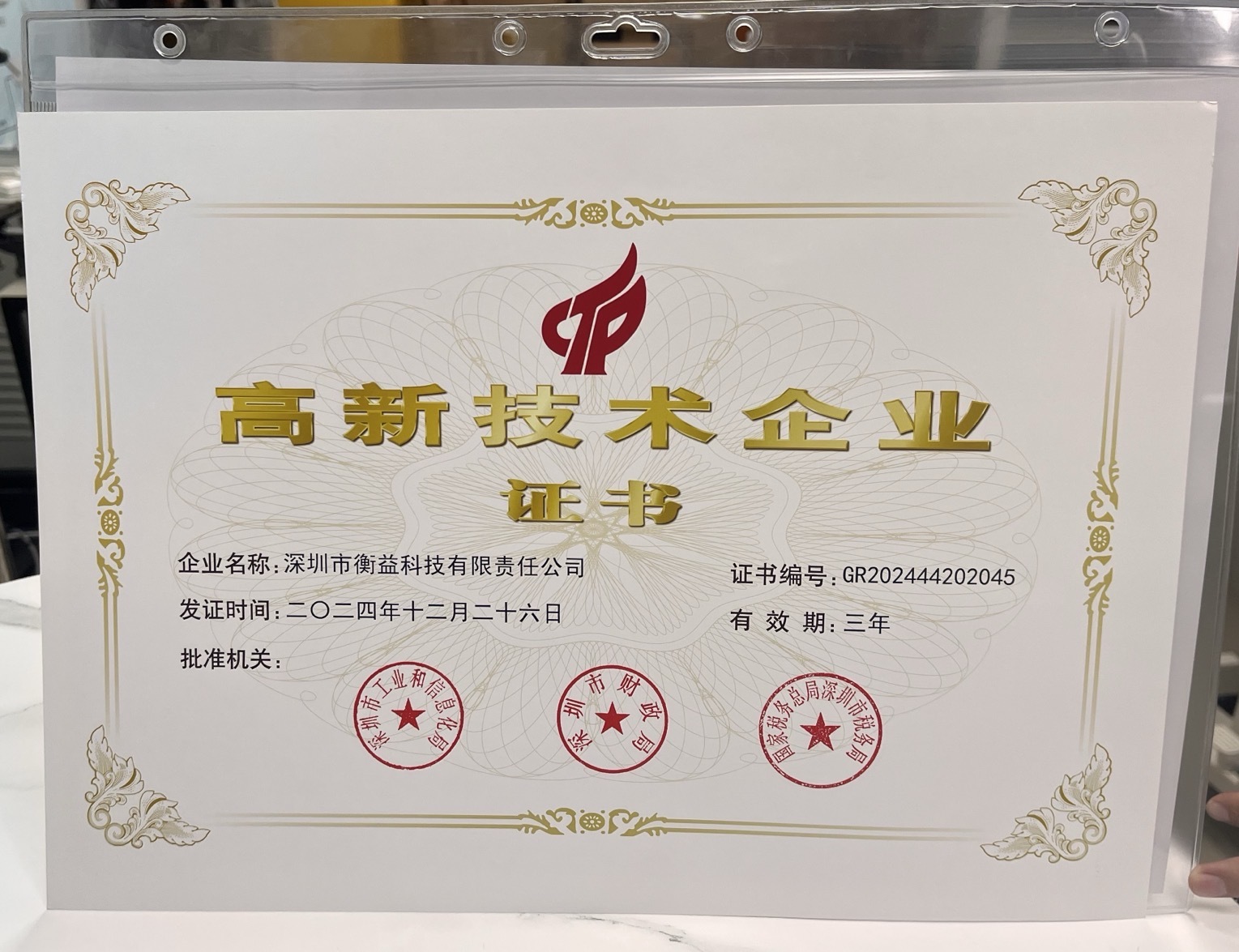
Shenzhen Hengyi Technology Co., Ltd. has successfully obtained the High-Tech Enterprise Certificate, thanks to its outstanding performance in technological research and development, innovation capabilities, and other areas. This prestigious recognition not only underscores the company’s comprehensive strength but also marks a significant milestone in Hengyi Technology’s journey of growth.
2025/03/14

Core Configuration of China’s Private LoRaWAN Network
The core configuration of China’s LoRaWAN private network is designed for low‑rate, long‑battery‑life IoT applications such as environmental monitoring and asset tracking. Its key design features include: - Unlicensed spectrum: No license required, making it ideal for enterprise‑built networks. - Spread‑spectrum anti‑interference: With a 125 kHz bandwidth and CSS modulation, it offers strong penetration and a coverage range of 10–15 kilometers. - Flexible networking: Supports star and mesh topologies, with gateways capable of demodulating up to eight concurrent channels (e.g., using the SX1301 chip).
2025/03/18

New Arrival – Multi-Point Infrared Thermometer
With the intelligent upgrading of power systems, the need for safety monitoring of distribution cabinets is becoming increasingly urgent. Traditional manual inspections rely on specialized personnel to open cabinets for testing, which is inefficient, costly, and often fails to promptly detect localized overheating risks caused by poor contact or overload, posing a significant fire hazard. In response, our company’s R&D team has focused on infrared sensing and IoT technologies to develop the HYT80 multi-point infrared thermometer. Featuring an 80×62 high‑precision infrared pixel array, this device delivers wide‑range temperature measurement from –20°C to 400°C with an accuracy of ±0.25°C. Coupled with multiple field‑of‑view options (45°/90°/105°) and MODBUS protocol compatibility, it enables non‑contact, real‑time monitoring of temperature changes inside distribution cabinets. By transmitting data over networks and leveraging big‑data analytics, it can proactively identify potential risks, providing an efficient, low‑cost, intelligent solution for power‑system safety.
2025/03/25
Contact Us
Tel:+86-189-23711266 400-1273-421
E-mail:liulin@rf-md.com
Shenzhen office: 506-509, zone 1, block B, Huayuan science and Technology Innovation Park, No. 168, Baoyuan Road, Xixiang, Bao'an District, Shenzhen
Changsha Branch: 21d, building F4, Lugu enterprise Plaza, No. 27, Wenxuan Road, Yuelu District, Changsha

Follow us
-

E-mail:
yangyalan@rf-md.com
-

Tel:
+86-755-23284193
-
